Best time to drive for Lyft: Peak hours and Prime Time patterns
Learn when Lyft demand is highest, how Prime Time affects your earnings, and how to plan your driving schedule around the hours that tend to pay the most.

The best time to drive for Lyft is Friday and Saturday nights, the hour or two around bar close, and the weekday morning and evening commutes. Weekday mid-mornings and early afternoons are usually the weakest stretch of the week. That pattern comes from what drivers commonly report and from Gridwise's 2025 earnings data for Uber and Lyft drivers [2]. Neither splits big cities from suburbs or rural areas, so use it as a starting point for your own market.
The reason is supply and demand. When riders outnumber drivers, fares go up. That's why two drivers can log the same hours in the same city and finish the week with very different totals.
Here's what this guide covers, so you can jump to the part you need:
What makes an hour worth driving on Lyft?
A good hour on Lyft isn't a fixed slot on a calendar. It's any stretch where more people in your area want rides than there are drivers online to take them. When riders outnumber drivers in a zone, Lyft pays more per ride to bring more drivers online. Lyft calls this Prime Time.
Prime Time shows up in the pay on each ride request, which already rises when there are lots of ride requests in the area [5]. Local conditions trigger it in the moment, which is why the same Tuesday at 6pm can be busy one week and flat the next.
Lyft's bonuses are separate and stack on top. In select regions, Turbo adds 10% to 40% per ride and is scheduled in advance, so you can plan around it. Flash Turbo appears on the map in real time when it's busy [4].
Lyft also gives you tools inside the driver app to see this before a request arrives:
Wait times on the map: shows where it's busy near you right now [3].
The weekly planner: shows your upcoming bonuses in one place, so you can plan when to drive [3].
Flash Turbo: zones on the map that move as demand changes, in regions where Lyft offers it. Drive into one and your next ride pays a bonus, even if it takes you out of the zone [4].
The ride request: in most cities, each request shows what you'll earn, the pickup and drop-off, and how long and how far the ride is [5].
On a busy night, you aren't guessing whether a ride is worth it, because the numbers are on the request. Your job is to decide, inside the platform's brief acceptance window, whether the ride pays enough for your time.
When is Lyft busiest?
Across markets, the same handful of windows keep coming up as Lyft's strongest. The table below sums up the pattern most drivers report: nights and weekends lead, commutes are steady, and weekday middays trail.
Daypart | What's usually happening | Typical demand | Prime Time odds |
|---|---|---|---|
Weekday morning commute (roughly 6am to 9am) | Commuters, airport runs, early shifts | Moderate to higher | Occasional, short-lived |
Weekday midday (roughly 10am to 3pm) | Errands, appointments, light airport traffic | Lower | Rare |
Weekday evening commute (roughly 4pm to 7pm) | Commuters heading home, dinner plans | Moderate to higher | Occasional |
Friday and Saturday nights | Dinners, bars, concerts, nights out | Higher | Common |
Around bar close (roughly midnight to 2am) | Everyone leaving at once, fewer drivers left online | Higher | Common, often steep |
After a big local event | A crowd hitting the app in the same 20 minutes | Spikes | Very common, very brief |
Treat those ranges as a starting point: a college town, a late-night downtown, and a spread-out suburb each bend the pattern differently.
Weekend nights and bar close
Weekend nights are the most consistent strong window because demand stacks up for hours: dinner, then bars and shows, then the ride home. Last call is commonly reported as the steepest part of that curve. Plenty of drivers have already gone home by then, so the riders who are left are spread across fewer cars.
Commutes and events
Commute windows are steadier. Prime Time pops up less often, but ride volume keeps you moving, and airport runs mixed in stretch a morning into longer trips. Events are the opposite: short, intense, and easy to miss if you aren't nearby when the crowd lets out.
Let's say it's 9pm on a Friday and you're parked a few blocks from a stretch of restaurants and bars. The ride request shows a 4-mile ride with a six-minute pickup, and the pay is higher than usual because it's busy. It's worth your time, so you take it. The same ride at 1:30pm on a Wednesday would pay the regular rate, and you'd likely sit longer waiting for the next one.
Why weekday mornings and early afternoons are usually the slowest
Once the morning commute winds down, most people who needed a ride are already at work. What's left is scattered: appointments, errands, a few airport trips. Meanwhile, part-time drivers who can only drive during school or office hours are all online at once. More drivers chasing fewer riders is the exact opposite of the imbalance that triggers Prime Time, so the pay rarely goes above the regular rate.
That doesn't make midday worthless. It changes what the job looks like:
Offers come in slower, so idle time between rides eats a bigger share of each hour.
Most rides pay the regular rate, so fewer of them are worth your time.
Your decision gets stricter, not faster. You're still reading the same fare, distance, and pickup time off the request, but a long pickup for a short ride costs you more when the next offer might be 15 minutes away.
Say it's 11am on a Tuesday and you get an offer for a 2-mile ride with a 12-minute pickup at the regular rate. On a weekend night you might take it to stay busy. On a slow Tuesday, the long unpaid pickup drags the whole hour down, so you let it pass and wait for something closer.
If midday is the only time you can drive, shorten the wait instead of adding hours: park near a hospital, a transit hub, or a business district rather than a quiet residential street. If you also deliver food, midday is a different story on the delivery side, and the breakdown of the best times to drive for deliveries covers that separately.
What hours pay the most on Lyft?
Most Lyft timing advice comes from forums and word of mouth. Two data sources back it up with real numbers.
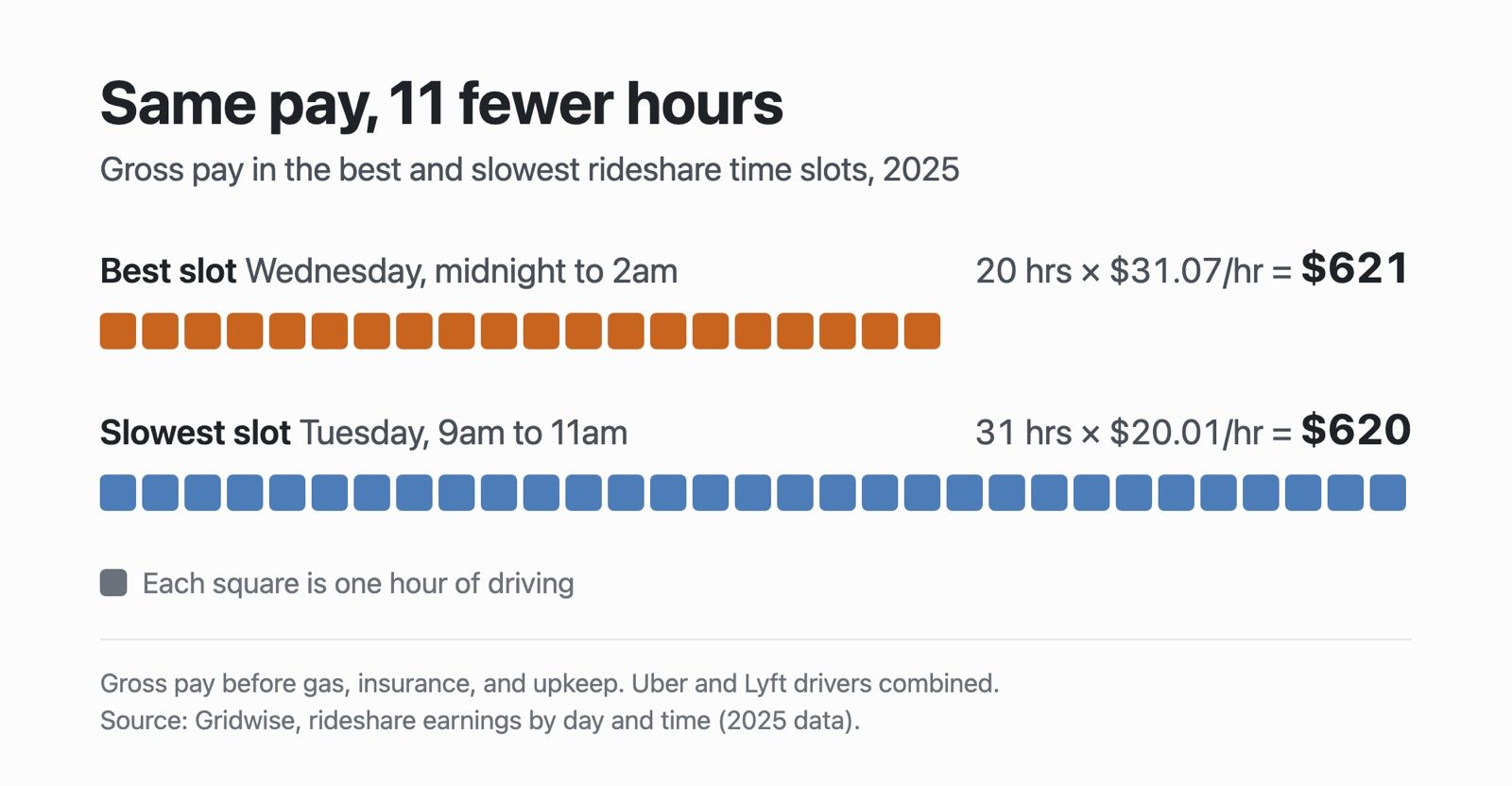
Gridwise's 2025 rideshare earnings by day and time, which combine Uber and Lyft, line up with the pattern above [2]:
The top slots were all late night: Wednesday midnight to 2am ($31.07/hr), Sunday midnight to 2am ($28.89/hr), Sunday 3am to 5am ($28.26/hr), and Saturday midnight to 2am ($28.14/hr).
The bottom slots were all weekday mornings and middays: Tuesday 9am to 11am ($20.01/hr), Wednesday 9am to 11am ($20.33/hr), and Tuesday noon to 2pm ($20.37/hr).
By Gridwise's math, 20 hours in the best slot grosses about the same as 31 hours in the slowest one. The Wednesday result is the surprise. If you're a night owl, a late weeknight is worth testing in your market.
Older research points the same direction. A 2019 Stanford Graduate School of Business write-up on two studies of Uber drivers found that younger drivers were more likely to work Friday and Saturday nights, the more lucrative hours, while older drivers skewed toward weekday daylight hours [1]. Experience mattered too. Drivers with 2,500 completed trips earned 14% more per hour than drivers with fewer than 100, because they'd learned where and when to drive. It's Uber data from before 2019, so read it as direction, not a Lyft forecast.
How Prime Time and driver-mode break rules affect your timing strategy
Knowing the peak windows is half of it. The other half is making sure you're rested, online, and in the right place when they arrive.
Where Prime Time tends to recur
Prime Time clusters around the same triggers week after week: weekend nights, last call, bad weather, and the end of big events. Rain that starts at 5pm on a weekday can turn an ordinary commute into one of the best hours of the week, because riders who would have walked all open the app at once. Surge chasing has its own traps, though, and Mystro's guide to surge pricing strategy covers when it's worth repositioning and when the zone will have cooled by the time you get there.
Lyft's 12-hour limit in driver mode
Lyft caps how long you can stay online. In most regions, you need a full, uninterrupted six-hour break for every 12 hours you spend in driver mode, and those 12 hours don't have to be consecutive. Time waiting in an airport queue, up to eight hours, doesn't count toward the limit. The details can vary by region, so check the rule where you drive.
That rule is easy to ignore until it costs you a Friday night. A slow afternoon online counts toward the same 12 hours as the Prime Time rush later.
Friday plan | Driver-mode hours used | What happens at 9pm |
|---|---|---|
Online from 8am, driving straight through | Close to 12 by early evening | You hit the limit and sit out the busiest stretch of the week |
Morning commute (6am to 9am), off until 5pm, then online | About three by 5pm | You have plenty of hours left through bar close |
Offline all day, online from 4pm | None by 4pm | Full room for the evening commute, the night, and bar close |
Let's say you drove the Friday morning commute from 6am to 9am. If you stay online through a slow midday out of habit, you burn hours you'll want at 11pm. Going offline at 9am, resting, and coming back at 5pm leaves you with about nine driver-mode hours for the evening commute, Friday night, and bar close.
The same logic works in reverse. If you plan to drive through bar close on Saturday, count back from 2am and make sure the six-hour break doesn't land in the middle of your best window.
How do you find the best time to drive Lyft in your city?
The patterns above are a starting point, but the schedule that matters is the one for your city, and the first question is where to start before you go online.
Lyft's own app map shows where demand is right now, while the Mystro Lyft Heatmap shows where it usually is at this hour on this day, so you can pick a starting zone before you leave instead of chasing the map once you're already on the road. The tool is free, covers the US and Canada, and maps where Lyft ride offers are concentrated and what they pay by day and time.
A simple way to use the two together:
Before your shift, open the Lyft Heatmap, set the day and time of your shift, and note the zones where offer density runs highest.
Head to the nearest strong zone and go online there, instead of going online from your driveway and hoping.
Once you're driving, switch to Lyft's in-app map, where wait times and Flash Turbo zones show what's happening in the moment.
Picture 4:30pm on a Saturday. You want to stay out until last call. The heatmap shows offer density on Saturday evenings building first near downtown and the arena district, not near your neighborhood. You drive there, go online at 5pm, and start the night inside the zone instead of spending the first half hour working your way toward it.
Running Lyft alongside another app during peak hours
Plenty of full-time drivers run Lyft and Uber together during peak hours, because a busy night on one platform is usually a busy night on the other, and two streams of offers means less time sitting between rides. The mechanics of driving for Uber and Lyft simultaneously are simple on paper. At 11pm on a Friday, doing it by hand gets hard.
Here's what the manual version asks of you, compared with what Mystro takes over:
Step in the loop | Doing it by hand | With Mystro |
|---|---|---|
Watching for offers | You monitor two apps at once | Mystro brings both apps online and shows every offer on one screen |
Deciding on an offer | You read the request and decide inside the platform's brief acceptance window | Mystro auto-accepts or auto-rejects the moment an offer matches your rules |
Offers that don't match a rule | You decide on every one | They surface for you to review inside the platform's normal window |
Protecting your acceptance rate | You toggle the other app offline after accepting, then back on after the drop-off | Mystro handles the app-switching for you |
The hard part of manual multi-apping is decision load. The ride request already shows the numbers, so there's nothing to calculate. What wears you down is deciding, over and over, whether they're worth it while you watch the road and keep the second app from pinging you mid-ride. With the phone in a dashboard mount, every glance at the screen at 35 mph is a small safety cost, and a Prime Time night means more of them.
Mystro calculates $/hr and $/mi for each offer and acts on the rules you set, which is useful whether you run two apps or just Lyft on its own. Auto-reject works the same for a single-app driver who wants to stop seeing low-paying rides during a slow midday. If you haven't set those rules yet, the guide to filtering out unprofitable rideshare trips walks through how drivers pick their thresholds.
Let's say it's 10:45 pm on a Friday and Lyft is in Prime Time while Uber is surging downtown. You set a rule that auto-accepts rides that pay more than your hourly target and auto-rejects anything with a long pickup. When a strong Lyft offer matches, Mystro accepts it immediately and takes Uber offline for the ride, then brings Uber back once you drop off. Your attention stays on the road instead of on two apps.
Frequently asked questions about the best time to drive for Lyft
Is Sunday a good day to drive for Lyft?
It depends on the part of Sunday. Early Sunday morning can carry leftover Saturday night demand and airport runs, and some drivers report it as surprisingly strong, though that varies a lot by city. Sunday afternoons tend to be quieter. The Mystro Lyft Heatmap shows how Sunday offer density looks in your own market.
What is Lyft Prime Time and when does it happen?
Prime Time is Lyft's higher pay when riders in an area outnumber available drivers. It shows up in the pay on each ride request [5]. Turbo and Flash Turbo are separate bonuses that stack on top [4]. It happens most often late on weekends, in bad weather, and after big events.
Do Lyft drivers make more at night?
Usually, yes. In Gridwise's 2025 earnings data, which combines Uber and Lyft, the four best-paying time slots all fell between midnight and 5am, led by Wednesday midnight to 2am at $31.07/hr [2]. A Stanford Graduate School of Business write-up on Uber drivers points the same way: Friday and Saturday nights were the more lucrative hours [1].
Should I run Uber and Lyft at the same time to catch more peak hours?
Many full-time drivers do, because it cuts the time you spend waiting between rides during busy windows. The catch is the extra decisions and the toggling needed to protect your acceptance rate. Mystro handles the accept, reject, and app-switching steps based on rules you set.
How many hours in a row can I drive for Lyft?
In most regions, Lyft requires a full six-hour break after every 12 hours in driver mode, and those hours don't have to be consecutive. Airport queue time, up to eight hours, doesn't count toward the limit. Plan the break so it doesn't fall during your best window.
How to plan your Lyft week around peak hours
Nights, weekends, last call, and the weekday commutes are where Lyft pays best, and weekday middays are where it pays least. Inside that pattern, you control two things: which hours you spend online, and how much effort each offer costs you once you're in them. Here's the order to work through it:
Check your market first. Open the Mystro Lyft Heatmap for the day and time you plan to drive and pick your starting zone.
Save your driver-mode hours for the peaks. Go offline during slow stretches so the 12-hour limit doesn't cut into Friday or Saturday night.
Get there before the window opens. Arrive in your zone and go online ahead of the rush, then switch to Lyft's in-app map for what's happening live.
Set your rules before the busy hours start. If running Lyft with a second app is the piece you haven't set up yet, download Mystro today.
References
[1] Shana Lynch. "Why Women and Older Workers Make Less Driving for Uber." Stanford Graduate School of Business, October 2, 2019. https://www.gsb.stanford.edu/insights/why-women-older-workers-make-less-driving-uber
[2] Gridwise. "How Much Do Lyft Drivers Make in 2026? (Real Data from 500k+ Drivers)." Gridwise, April 1, 2026. https://gridwise.io/blog/how-much-do-lyft-drivers-make
[3] Lyft. "The driver's guide to pay." Lyft, accessed October 6, 2026. https://www.lyft.com/driver/earnings
[4] Lyft. "The driver's guide to bonuses." Lyft, accessed October 6, 2026. https://www.lyft.com/driver/bonus
[5] Lyft. "Upfront pay." Lyft Help, accessed October 6, 2026. https://help.lyft.com/hc/en-us/articles/8668928544-Upfront-pay
This post first appeared in The Mystro Newsletter — driver tips, earnings strategies, and Mystro updates, in your inbox every week.