DoorDash vs. Uber Eats: Which one pays and tips better?
Here's how to tell which one pays more in your market.

Every driver has an opinion on DoorDash vs. Uber Eats. So this week, we went straight to the numbers to see if we could find an answer. We pulled from a 500,000-driver earnings dataset, a UC Berkeley study of more than 52,000 trips, New York City's report on tipping, and new research on Seattle's minimum-pay rules. Then we set all of it next to what DoorDash and Uber say their drivers make. Here’s what we found:
Like posts that are grounded in research? Or prefer posts focused on driver insights. Tell us so we can better cater the topics to what you want to read.
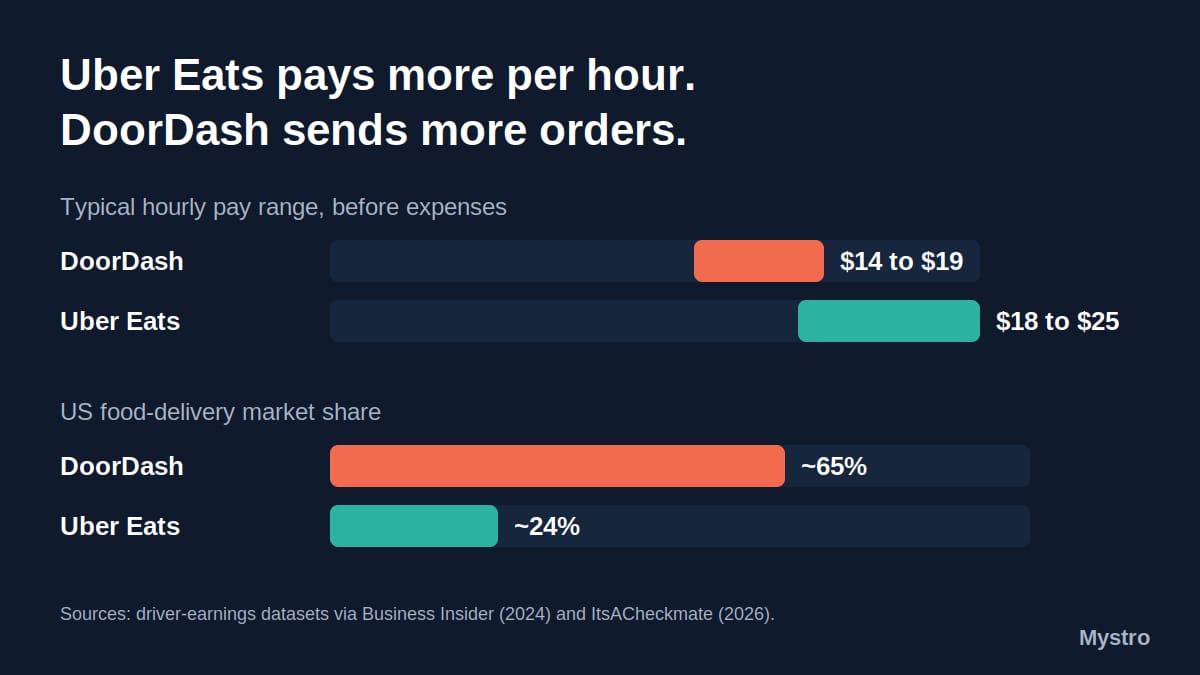
Uber Eats tends to pay more per hour. DoorDash tends to hand you more orders. That's why this question never gets a clean winner. The data shows Uber Eats ahead on hourly pay, with Business Insider's 2024 report on a 500,000-driver dataset putting it at $18 an hour to DoorDash's $14 [1]. DoorDash's much larger share of the US delivery market means fewer dead minutes between drops in most places you'd actually work.
Which one is better for you depends on your market's density, the hours you can work, and how much of your shift you sit idling. A driver in a dense downtown core who can pick off long, well-tipped Uber Eats routes is playing a different game than a driver in a spread-out suburb where DoorDash is the only app with steady volume after 8 pm.
Run both instead of choosing: Plenty of drivers skip the choice and run both apps together, with Mystro handling the app-switching between them.
The rest of this article covers:
Pay and tip figures move. Platforms change pay models, cities pass new minimum-pay rules, and new datasets come out every year. This post was last updated: Monday, October 8th, 2026.
Does DoorDash or Uber Eats pay more?
Uber Eats generally pays more per hour. DoorDash generally delivers more orders per hour. The table below is the short version of the difference before we get into why it happens.
What you're comparing | DoorDash | Uber Eats |
|---|---|---|
US food-delivery market share [2] | Roughly 65% | Roughly 24% |
Typical hourly pay range, before expenses | Roughly $14 to $19 depending on year and market | Roughly $18 to $25 depending on year and market |
Order volume | Higher; more restaurant partners and denser order flow | Lower total volume, longer average routes |
Average tip per delivery, NYC [3] | $0.76 | $0.76 |
Driver-earnings trackers put Uber Eats somewhere between $18 and $25 an hour and DoorDash between $14 and $19, before expenses. The exact figure depends on which year the dataset covers, which cities it samples, and whether expenses were taken out. Business Insider's 2024 report on a 500,000-driver dataset puts it at $18 an hour for Uber Eats and $14 for DoorDash. A more recent restaurant-industry comparison from ItsACheckmate lands closer to $20 and $14.81.
The dollar amounts change from source to source. The order doesn't. According to sources like Business Insider and ItsACheckmate, Uber Eats comes out ahead on hourly pay and DoorDash comes out ahead on order volume, thanks to its bigger market share.
Beyond DoorDash and Uber Eats: For the full pay comparison across every platform drivers run, Sergio Avedian's breakdown of which gig app pays the most covers all of them in one place.
Why Uber Eats tends to pay more per hour
The per-hour edge isn't a higher base rate. It's the shape of the orders.
Uber Eats sends fewer total offers in most markets, but the ones it sends tend to run longer routes, and longer routes in dense urban cores tend to carry better tips. Multiple driver-earnings trackers show that pattern holding across years, even as the absolute dollar figures shift between datasets. Add surge and Boost pricing on weekend nights and late evenings, and a smaller number of well-chosen orders can beat more short suburban runs on dollars per hour.
The UC Berkeley Labor Center's study of five metro areas found that 48% of Uber Eats drivers in California received a Prop 22 minimum-pay adjustment, compared to 66% of DoorDash drivers [4]. That adjustment only kicks in when base pay falls below the guaranteed floor, so a lower share means Uber Eats base pay clears the floor on its own more often.
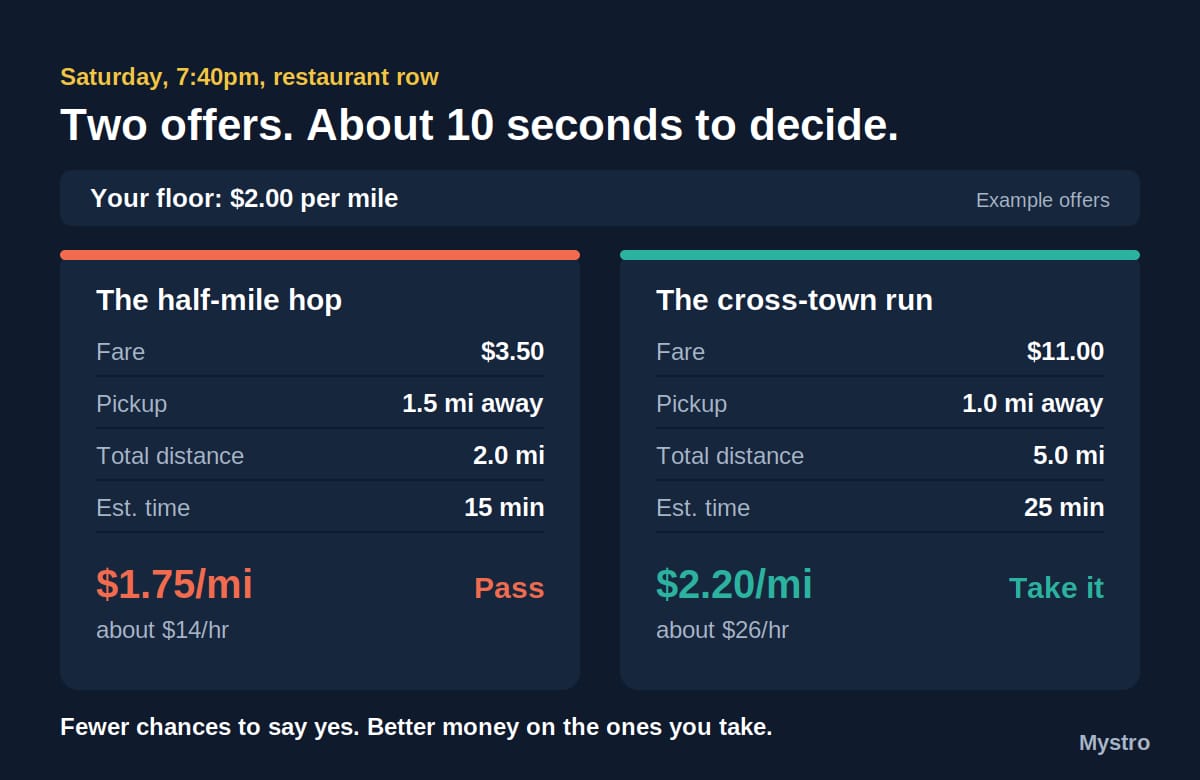
Let's say it's 7:40 pm on a Saturday and you're parked near a restaurant row. An offer card comes up showing the fare, the distance, the pickup time, and the trip duration. You decide in about 10 seconds whether those displayed numbers clear your dollars-per-mile threshold, and on Uber Eats in that window, the ones that clear it tend to be the four-mile runs across town rather than the half-mile hops. That's the trade: fewer chances to say yes, better money on the ones you take.
Know your cost per mile before you set that threshold: Mystro's free Cost Per Mile Calculator works out what every mile really costs you in gas, maintenance, and depreciation in about five minutes, so your dollars-per-mile floor is based on your car, not a guess.
Why DoorDash tends to deliver more total orders
DoorDash holds roughly 65% of the US food-delivery market while Uber Eats holds roughly 24% [2]. So it makes sense that you get more orders with DoorDash. They have more regular orders coming in for you to take.
Here's what that bigger market share means for you:
Restaurant density: More partner restaurants in a given radius means more simultaneous order flow, which means shorter waits between drops.
Suburban and rural reach: Outside dense metros, DoorDash is often the only app with enough volume to fill a shift at all.
Order frequency: More total orders per hour means less unpaid idle time, and idle time is the biggest single drag on anyone's hourly number.
This is why a lower per-hour rate can still produce a bigger day. If DoorDash keeps you moving for six straight hours while Uber Eats leaves you sitting for 40 minutes of that same stretch, the higher-rate platform can lose on total dollars. The only way to know which one wins in your market is to run both for a week and compare your own numbers.
Do DoorDash or Uber Eats drivers get better tips?
In the best data available, they're tied, and both are low. Both platforms changed how customers tip at checkout, and drivers are taking home less because of it. Most DoorDash vs. Uber Eats comparisons skip this part.
New York City's Department of Consumer and Worker Protection found that tipping-interface design changes on Uber Eats and DoorDash drove delivery-worker tips down by more than $550 million, while tips held steady on rival platforms whose checkout interfaces didn't change [3]. The current average tip on those two platforms sits at $0.76 per delivery, compared to $2.17 per delivery on restaurant-direct apps that still present tipping at checkout.
So this means, at 20 deliveries a day:
Uber Eats or DoorDash ($0.76 tip) | Restaurant-direct apps ($2.17 tip) | What you're missing | |
|---|---|---|---|
One delivery | $0.76 | $2.17 | $1.41 |
One day (20 deliveries) | $15.20 | $43.40 | $28.20 |
Five-day week | $76 | $217 | $141 |
That's before you've paid for a single mile of gas. DCWP puts the yearly loss at about $5,800 per worker. That's a car payment and an insurance premium, gone, without a single change to how hard you drive.
The Seattle data shows the same mechanism from a different angle. When the city's 2024 minimum-pay ordinance took effect, base pay per task jumped from $5.37 to $12.52, but average tips fell far enough to cancel out more than a third of that gain, partly because platforms disabled upfront tipping for Seattle customers [5]. Task volume for drivers already on the apps fell at least 20% within a month as new drivers signed on to chase the higher base.
What independent pay research shows beyond what either platform advertises
Both companies publish hourly figures that look nothing like the third-party numbers, and it's worth comparing them side by side.
The UC Berkeley Labor Center analyzed 52,370 trips by 1,088 drivers across five major metro areas. For delivery workers, median net hourly earnings after expenses and excluding tips came to $5.93 in California and $0.48 in the metros outside it [4]. Adding tips back in brought those figures to $13.62 and $9.87 respectively, still below local minimum wage in most of the metros studied.
The companies dispute this. DoorDash said California Dashers averaged roughly $36 an hour on deliveries in 2023, and Uber said its drivers nationally earn more than $30 an hour [1]. Independent researchers haven't been able to check either figure against the companies' own trip-level data, and that's the real reason the two sides disagree.
Source | What it measures | Delivery driver pay |
|---|---|---|
UC Berkeley Labor Center | Median net hourly, after expenses, excluding tips, five metros | $5.93 in California, $0.48 elsewhere |
UC Berkeley Labor Center | Same, with tips included | $13.62 in California, $9.87 elsewhere |
DoorDash company figure | California Dasher average on deliveries, 2023 | About $36/hr |
Uber company figure | US driver average | More than $30/hr |
Why are the numbers so far apart? The companies count what you make per hour while you're on a delivery. The researchers count everything else too: the gas, the wear on your car, and the minutes you sit waiting between orders. Both are doing the math right. They're just counting different hours, and the hours you actually work look more like the researchers' version.
To see where those expenses go, Mystro's rideshare taxes guide covers mileage and deductions.
Multi-apping both platforms instead of picking one
Plenty of experienced drivers never answer the DoorDash-or-Uber-Eats question, because they run both and take whichever offer clears their threshold first.
The logic is simple once you've seen the numbers above. DoorDash's volume fills the gaps where Uber Eats goes quiet, and Uber Eats' longer, better-paying routes are worth grabbing when they appear. Running both turns the platforms' weaknesses into each other's coverage, and it directly attacks idle time, which is the one variable that hurts hourly pay on either app.
Doing it by hand is the problem. Manual multi-apping means watching two apps, reading each offer card as it comes up, deciding inside the platform's roughly 10-second window, and then toggling the other app offline once you've accepted so an incoming ping doesn't hit your acceptance rate mid-delivery. Then toggling it back on when you drop. That's a lot of decision load at 35 miles an hour, and the safety cost is real whether you run one app or two.
Mystro automates that loop. You set your dollars-per-hour and dollars-per-mile rules, and Mystro auto-accepts or auto-rejects the moment an offer matches, then handles the app-switching so the second platform goes offline while you're on a delivery. It's useful for single-app drivers too: auto-reject and offer filtering work the same way whether you're running DoorDash alone or both platforms together. If dialing in those thresholds is the part you haven't worked out, the guide to filtering out unprofitable trips walks through how drivers set them.
The same toggling mechanics apply whether you're running two rideshare apps or a rideshare-plus-delivery combination, and the mechanics of driving for Uber and Lyft simultaneously transfer directly to a DoorDash plus Uber Eats pairing.
Download Mystro and run DoorDash and Uber Eats together without touching your phone mid-delivery.
So which one should you drive for?
There's no universal winner, and any post that gives you one is guessing about your market. Uber Eats tends to win on per-hour pay in dense urban markets where long routes and better tips are available. DoorDash tends to win on order volume and consistency, especially outside city centers, which can mean more total dollars even at a lower rate.
Tipping-interface design has pulled money off both platforms, so neither one is protecting your tips for you. And the independent research suggests that what you net after expenses matters more than which logo is on the app.
Here's the order to work through it:
Run each app for a week and track your real dollars per hour. Use the fare and distance figures off the offer cards, not the in-app weekly summary, which doesn't know about your gas or your miles. Mystro's free Cost Per Mile Calculator gives you the per-mile cost to subtract.
Run both simultaneously during peak windows instead of picking one exclusively, so the idle time on one platform gets filled by the other.
Automate the toggling and the accept-reject calls if the manual version is eating your attention with Mystro.
Frequently asked questions about DoorDash vs. Uber Eats for drivers
Which pays more, DoorDash or Uber Eats?
Uber Eats pays more per hour across most third-party driver-earnings datasets, with figures commonly landing between roughly $18 and $25 an hour compared to DoorDash's roughly $14 to $19, before expenses. DoorDash typically delivers more orders per hour because of its much larger market share, so total daily earnings can still come out ahead on DoorDash in markets where Uber Eats volume is thin.
Can I drive for both DoorDash and Uber Eats at the same time?
Yes. Neither platform requires exclusivity, and running both is a common strategy for filling the idle minutes that drag down hourly pay on either one. The friction is manual: two apps to watch, offers to judge inside a roughly 10-second window, and the second app to toggle offline once you accept so your acceptance rate doesn't take a hit. Mystro handles that switching and the accept-reject rules automatically.
Is it better to drive DoorDash or Uber Eats in a big city?
Dense urban markets are where Uber Eats' per-hour advantage shows up most clearly, because longer routes and better tips are both more available. In suburban and rural areas, DoorDash's restaurant density and order frequency usually matter more than the hourly rate, since an app that leaves you sitting can't pay you at all.
Do independent studies agree with what DoorDash and Uber Eats report about driver pay?
No, and the gap is large. The UC Berkeley Labor Center found median net hourly earnings for delivery workers of $5.93 in California and $0.48 in other metros after expenses and excluding tips, or $13.62 and $9.87 with tips included. DoorDash has said California Dashers averaged about $36 an hour on deliveries in 2023, and Uber has said drivers nationally earn more than $30 an hour. The company figures describe gross pay during active delivery time; the academic figures net out expenses and unpaid waiting.
That's the full picture as of right now. The numbers will shift as pay models change and new research comes out, and we'll keep checking.
We're planning more data-driven breakdowns like this one. If this was useful, tell us. Our two-minute reader survey asks what you drive, where you drive, and what you want us to dig into next. Your answers decide what we cover.
References
[1] Noah Sheidlower, Jacob Zinkula. "Uber, Lyft, DoorDash Drivers Earn Below Minimum Wage: Study." Business Insider, May 21, 2024. https://www.businessinsider.com/uber-lyft-doordash-drivers-earn-below-minimum-wage-tips-study-2024-5
[2] Jared Castronova. "DoorDash vs. Uber Eats: Compare Fees, Speed, and Growth." ItsACheckmate, 2026. https://www.itsacheckmate.com/blog/doordash-vs-ubereats-which-food-delivery-service-is-better
[3] NYC Department of Consumer and Worker Protection. "DCWP Report Shows Uber and DoorDash Drove $550 Million in Delivery Worker Pay Losses." City of New York, January 13, 2026. https://www.nyc.gov/site/dca/news/005-26/dcwp-report-shows-uber-doordash-drove-550-million-delivery-worker-pay-losses
[4] UC Berkeley Labor Center / Center for Wage and Employment Dynamics (Ken Jacobs et al.). "Gig Passenger and Delivery Driver Pay in Five Metro Areas." UC Berkeley Labor Center, May 20, 2024. https://laborcenter.berkeley.edu/gig-passenger-and-delivery-driver-pay-in-five-metro-areas/
[5] Yuan An, Andrew Garin, Brian K. Kovak. "Impact of Minimum Pay Rules on Gig Delivery Drivers." National Bureau of Economic Research, March 2026. https://www.nber.org/digest/202603/impact-minimum-pay-rules-gig-delivery-drivers
This post first appeared in The Mystro Newsletter — driver tips, earnings strategies, and Mystro updates, in your inbox every week.