Does Uber or Lyft pay more?
Here's what the data shows.

Uber pays a little more per hour than Lyft in most US markets, but how much more depends on where and when you drive. The gap sits somewhere around $1.70 an hour. It also shifts with your city, the time of day, and which app has more riders that week. There's no clear winner here. Uber just has a slight edge.
The gap that actually matters is a different one: what you make versus what you keep. Once gas, wear on your car, and taxes come out, that difference is far bigger than anything separating Uber from Lyft.
ShiftTrackerApp looked at data from 500,000 drivers in 2026. Uber's median came in at $21.18 an hour and Lyft's at $19.48 [1]. That's about $1.70 an hour, before you've paid for a single gallon of gas.
Metric | Uber | Lyft |
|---|---|---|
Median gross hourly pay (2026) | $21.18 | $19.48 |
Platform fee | Commonly cited at 20-25%, varies by trip and city | Capped at 30% of passenger payments before external fees |
US market share | Larger; roughly 70% of US rideshare spending | Smaller |
Tips | 100% to the driver | 100% to the driver |
Driver support | In-app help and phone support through the Driver app, plus in-person Greenlight Hubs by appointment [7][8] | 24/7 chat through the Driver app; in-person Hubs closed [9] |
For the same driver working the same market on the same schedule, the gap is usually under 10%, often within $1 or $2 an hour. A $1.70 spread is real, but it's thin enough that a single well-timed surge hour or one badly chosen airport queue erases it.
Older survey data points the same direction with different numbers. Life Asset's driver-survey figures put Uber at $19.73 an hour against Lyft's $17.49 before expenses [2], a roughly $2.20 spread from a different dataset. The magnitude shifts. The direction holds.
Why Uber usually edges ahead on hourly pay
The gap isn't really about per-ride rates. Both platforms price rides similarly enough that a single trip on either one, in the same market at the same hour, tends to pay within pennies of the other.
What differs is volume. Uber holds the larger US market share, and roughly 70% of US rideshare spending goes through it [11]. More requests means shorter gaps between trips, and unpaid idle time is the single biggest drag on hourly earnings. A driver who completes five rides in an hour on Uber and four on Lyft earns more, even if each individual ride pays identically.
That advantage narrows sharply in dense metros. In a downtown core during a Friday evening rush, both platforms have deep enough demand that a driver rarely waits on either one. The market-share edge only pays off where demand is thin enough that the wait between pings is a real cost, which is most of the country most of the time, but not everywhere.
Where Lyft competes, and sometimes wins
Lyft can't beat Uber on ride volume, so it competes on how it pays you instead. And sometimes it works.
The fee cap is the best example. Lyft's cut can't go above 30% of what riders pay, counted before outside costs like insurance, taxes, and government fees come out. If Lyft's cut runs over 30% across all your rides in a month, it pays you the difference [3].
Uber doesn't publish a cap. It calls its cut a service fee and says the fee changes by trip and city. Driver advocates usually put it somewhere between 20% and 25% [4]. Neither company's cut stays the same from ride to ride, so treat both numbers as ranges, not guarantees.
Mechanic | Uber | Lyft |
|---|---|---|
Fee structure | Service fee varying by trip and city, commonly 20-25% | Capped at 30% of passenger payments before external fees, with a monthly adjustment if exceeded |
Bonus programs | Quest, Boost+ | Turbo, Flash Turbo, Ride Challenges |
Demand pricing | Surge | Prime Time |
The fee cap is worth more than it looks. It applies to every Lyft driver, every month, so a veteran driver gets the same protection as someone in their first week. If Lyft's cut creeps past 30% over a month, the difference comes back to you.
Driver support is the other line worth knowing before something goes wrong mid-shift. Uber offers in-app help and phone support through the Driver app and still runs in-person Greenlight Hubs, now by appointment [7][8].
Lyft closed its Hub locations and moved driver support to 24/7 chat inside the Driver app [9]. Neither is a pay difference on paper, but a day of lost driving over an unresolved account issue costs more than a week of the $1.70 gap.
How base pay, surge, and bonuses actually work
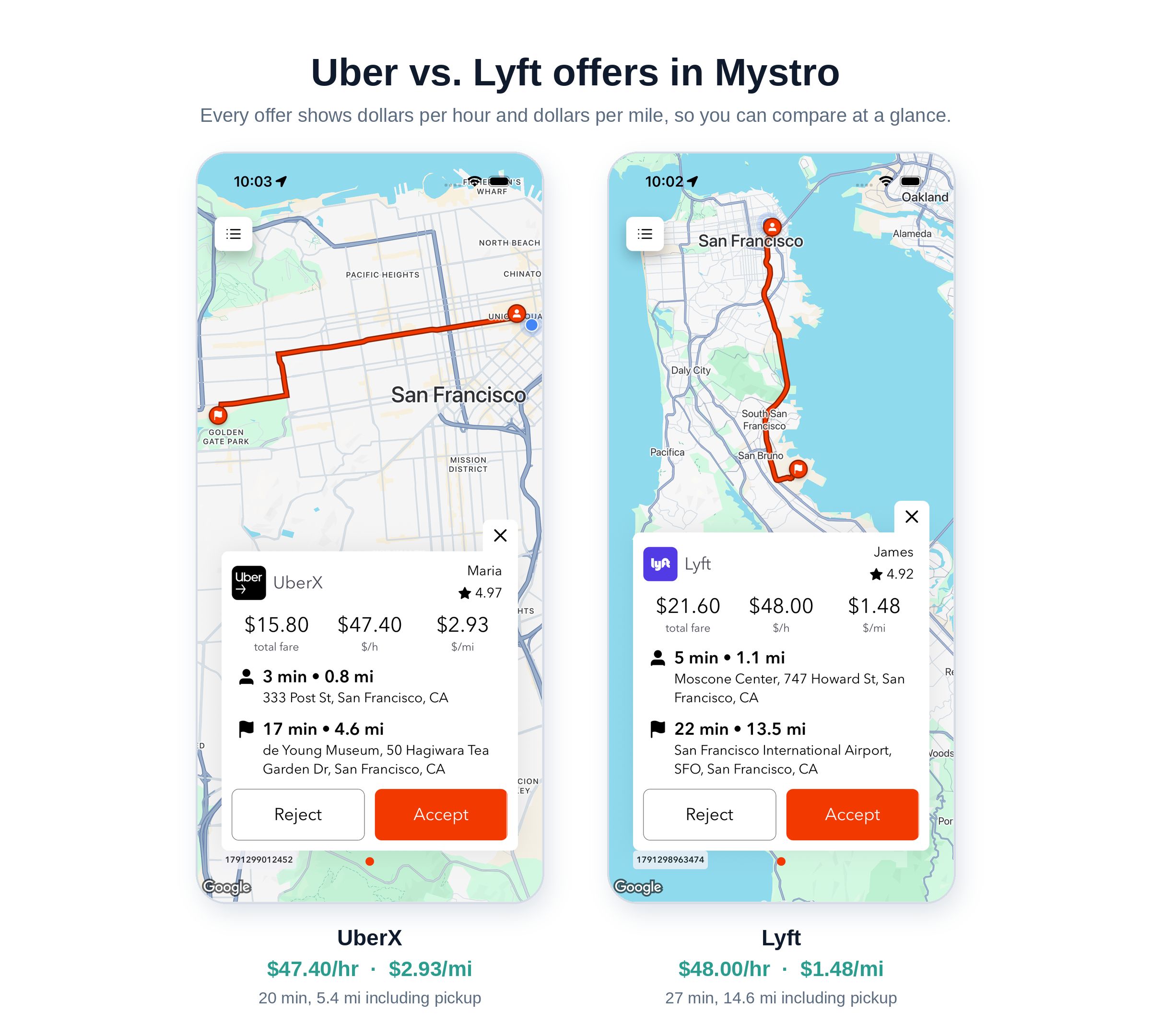
Both platforms have converged on upfront pricing in most markets. When an offer comes in, the card on your screen displays the fare, the distance, the pickup time, and the trip duration before you decide anything. You read those numbers off the card. You're not estimating them, and you get a short countdown to decide whether they clear your threshold.
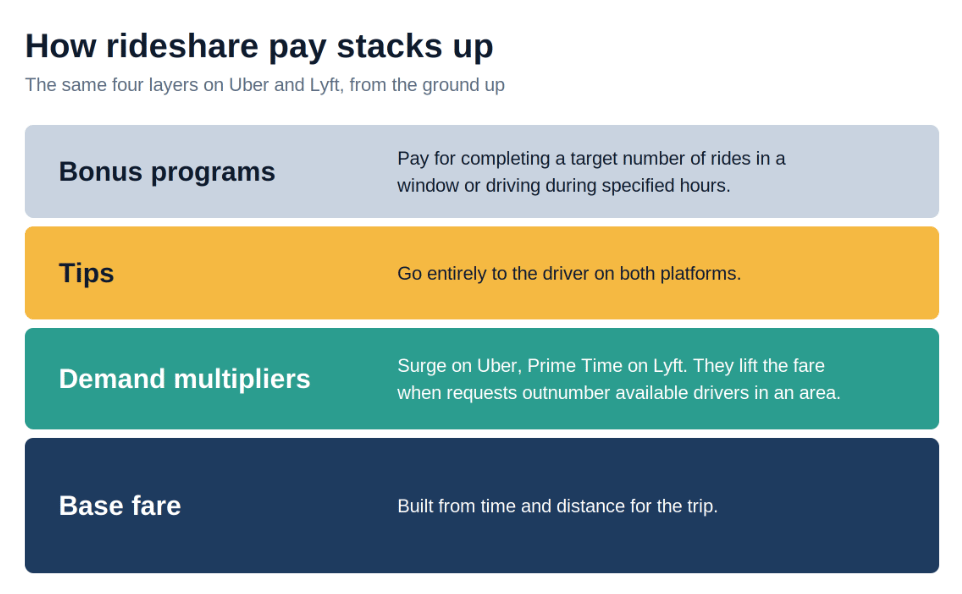
The pay itself stacks in layers on both apps:
Base fare: Built from time and distance for the trip.
Demand multipliers: Called surge on Uber and Prime Time on Lyft, which lift the fare when requests outnumber available drivers in an area.
Tips: Which go entirely to the driver on both platforms.
Bonus programs: Which pay for completing a target number of rides in a window or driving during specified hours.
Bonus structures differ in naming more than in kind. Uber runs Quest and Boost+; Lyft runs Turbo, Flash Turbo, and Ride Challenges [3]. Both reward volume and timing rather than ride quality, which is exactly why a driver chasing a bonus will sometimes accept trips that would fail their normal dollars-per-hour test. Deciding when a bonus is worth breaking your own rules is its own skill, and filtering out the trips that never clear your threshold is the other half of it.
The data says you shouldn’t rely on tips. The Illinois Economic Policy Institute's analysis of 22 million Chicago rideshare trips between January and June 2021 found that only 17% of rides resulted in a tip to the driver [5]. That's Chicago-specific and several years old, but it's a useful corrective to earnings estimates that treat tips as a reliable line item. Lyft's own figure points the same way: tips made up 8% of driver earnings on average in 2023 [3].
How much do Uber and Lyft drivers actually keep?
Uber pays $1 to $2 more an hour than Lyft. What you lose to expenses is a lot more. In the Chicago study, drivers made $27 an hour before costs. After gas, car expenses, and taxes, they kept about $13. That's $14 an hour gone [5].
Here are the three things you control to increase your payout:
Choose the best offers. Set a dollars-per-hour and dollars-per-mile floor and turn down anything under it. Every ride that pays below your cost per mile funds someone else's trip out of your depreciation, and the deadhead miles to reach the pickup make it worse. Many drivers have never worked out that number for their own car; a cost-per-mile calculator settles it in a few minutes.
Minimize idle time. Unpaid waiting is the tax on rideshare work, and it's the mechanism behind Uber's own hourly edge. Anything that shortens the gap between rides converts directly into hourly pay. The full set of earnings levers a driver controls starts here.
Run both Uber and Lyft. ShiftTrackerApp estimates that drivers running two apps simultaneously earn 15-25% more than single-app drivers, largely by eliminating dead time on any one platform [1]. That's an industry estimate rather than a peer-reviewed finding, so treat the range as directional. The mechanism behind it isn't in dispute: two offer streams fill gaps that one can't.
The catch with multi-apping is the manual version of it. Running both platforms at once means watching two apps, reading each offer card inside the platform's countdown, and toggling the second app offline the moment you accept a ride so an ignored ping there doesn't dent your acceptance rate. Then toggling it back on when the ride wraps. Doing that at 35 miles an hour is the reason many drivers try multi-apping and quit within a week.
This is the loop Mystro automates. It brings all your apps online, surfaces every offer on one screen, calculates dollars per hour and dollars per mile for each one, and auto-accepts or auto-rejects immediately when an offer matches the rules you set. Offers that don't match a rule pass through to your screen with the platform's normal window intact. The app-switching side handles the toggling automatically, so the second app goes offline during a ride and back on after. Drivers who want the specifics can read the step-by-step version of running Uber and Lyft together.
Can Uber and Lyft drivers deduct mileage?
Yes, and it's the one lever that sits outside both platforms. The IRS standard mileage deduction for 2026 is 72.5 cents per mile for January through June and 76 cents per mile from July 1 onward [10]. A driver logging 25,000 business miles a year is deducting roughly $18,500, which reshapes the net-earnings picture far more than a $1.70 hourly difference does. Logging every mile isn't optional bookkeeping. It's one of the largest single levers in the whole calculation, and the complete guide to rideshare taxes covers the rest of the deduction picture.
Frequently asked questions about Uber vs. Lyft driver pay
Which pays more, Uber or Lyft?
Uber pays slightly more in most US markets. ShiftTrackerApp's 2026 data puts Uber's median at $21.18 an hour gross against Lyft's $19.48, a gap of about $1.70. The lead is market-dependent and can flip in specific cities.
What is the average hourly pay for Uber and Lyft drivers?
Gross figures cluster around $19 to $22 an hour before expenses. Net figures are much lower and much more contested: a 2020 study commissioned by the City of Seattle found $9.73 an hour after expenses [6], while a Chicago analysis found $13 an hour in W-2-equivalent wages against $27 gross [5].
Why is there a pay gap between Uber and Lyft?
Mostly market share. Uber gets more ride requests across most of the country, which means less unpaid idle time between trips. Per-ride rates on the two platforms are broadly similar; the hourly difference comes from how often a driver is actually carrying a passenger.
Does multi-apping actually increase earnings?
ShiftTrackerApp estimates a 15-25% lift over single-app driving, driven by less dead time between rides. That's an industry estimate rather than peer-reviewed research, so read it as directional. The gain is largest in slower markets where a driver would otherwise sit idle 10 to 15 minutes between pings, and smallest in busy markets where good offers arrive constantly on one app.
Which platform takes a bigger cut?
It depends on the trip. Lyft's fee is capped at 30% of passenger payments before external fees, with an earnings adjustment if the monthly total exceeds it. Uber's service fee varies by trip and city and is commonly reported between 20% and 25% [4]. Neither is a fixed number you can plan around.
Do tips make up the difference?
Rarely, and less often than earnings estimates tend to assume. Both platforms pass 100% of tips to the driver, but the Illinois EPI's Chicago study found only 17% of rides between January and June 2021 produced a tip at all [5].
Is it better to drive for Uber or Lyft?
Uber pays a little more per hour than Lyft across most of the US, and the difference is small enough that it shouldn't be the deciding factor in how you run your week. Where you drive, when you drive, and which offers you turn down all move your earnings more than the logo on the app. The gross-to-net question moves it most of all.
The levers worth pulling are the ones you own: a firm dollars-per-hour floor on every offer, less unpaid time between rides, and every business mile logged.
References
[1] Brenden Warn. "Uber vs Lyft Pay 2026: Which Driver Makes More?" ShiftTrackerApp, June 29, 2026 (modified July 28, 2026). https://shifttrackerapp.com/blog/lyft-vs-uber-which-pays-drivers-more-in-2026
[2] Life Asset. "Uber vs. Lyft Driver: Who Pays Better?" Life Asset. https://lifeasset.org/uber-vs-lyft/
[3] Lyft. "The driver's guide to pay." Lyft. https://www.lyft.com/driver/earnings
[4] Dimitri Gedevanishvili. "Driving for Uber vs. Lyft | Does Uber or Lyft Pay More in 2026?" TripLog, August 11, 2026. https://www.triplog.net/blog/driving-for-uber-vs-lyft-does-uber-or-lyft-pay-more
[5] Frank Manzo IV, Larissa Petrucci, Robert Bruno. "Improving Labor Standards for Uber and Lyft Drivers in Chicago: Classifying Drivers as Employees." Illinois Economic Policy Institute / University of Illinois at Urbana-Champaign, March 14, 2022. https://lep.illinois.edu/wp-content/uploads/2022/03/ILEPI-PMCR-Improving-Labor-Standards-for-Uber-and-Lyft-Drivers-FINAL.pdf
[6] James Parrott and Michael Reich. "A Minimum Compensation Standard for Seattle TNC Drivers." Report for the City of Seattle, July 2020. https://www.seattle.gov/documents/departments/laborstandards/parrott-reich-seattle-report_july-2020.pdf
[7] Uber. "Call Uber Support | Driver Customer Service." Uber. https://www.uber.com/us/en/drive/driver-app/phone-support/
[8] Uber. "I need to visit a Greenlight Hub." Uber Help. https://help.uber.com/en/driving-and-delivering/article/i-need-to-visit-a-greenlight-hub?nodeId=6970a03f-3ad0-4fd3-ba02-715d23750e3e
[9] Lyft. "Hub Hours." Lyft. https://www.lyft.com/hub/hours
[10] Internal Revenue Service. Announcement 2026-11, July 13, 2026. https://www.irs.gov/tax-professionals/standard-mileage-rates
[11] Bloomberg Second Measure. "Market share of the leading ride-hailing companies in the United States." Via Statista, April 2024. https://www.statista.com/statistics/910704/market-share-of-rideshare-companies-united-states/
This post first appeared in The Mystro Newsletter — driver tips, earnings strategies, and Mystro updates, in your inbox every week.