How to appeal an Uber, Lyft, or DoorDash deactivation with AI
Learn which deactivations are worth appealing, and how to use AI to build a case that sticks to the facts.

Getting deactivated can wipe out a driver’s income overnight, and the appeal is often your only shot at getting it back. So we asked Sergio how to make sure your writing the best appeal possible. He’s driven rideshare and delivery for about a decade, and he hears from deactivated drivers every week. His advice: don’t vent, build a case.
Here’s how to do that, and how AI can help you write it.
If you’ve been deactivated, your appeal is your best shot at getting back on the app. Don’t waste it on anger, excuses, or a 2,000-word life story. Build a case. AI can help you write it, but the evidence has to come from you.
Getting deactivated from Uber, Lyft, or DoorDash isn’t like getting a bad rating. A bad rating might hurt your ego. A deactivation can stop your income tomorrow morning.
And this is where AI can actually be useful to drivers. It can take your facts, organize your evidence, and help you write a calm, specific, professional appeal in minutes instead of sitting there staring at your phone trying to figure out what to say.
Getting it right matters because you may not get a second chance. Lyft, for example, allows only one appeal per permanent deactivation. So if you’re going to appeal, don't treat it like another support ticket. Treat it like your livelihood depends on getting the facts right because it just might.
Why do Uber, Lyft, and DoorDash deactivate drivers?
There isn't one universal reason. Each platform has its own rules, and some deactivations are much easier to resolve than others.
Uber says the most common reasons drivers and couriers lose access are expired documents and Real-Time ID Check failures. Those checks confirm the person driving is the account holder, and most failures are avoidable: letting someone else take the photo, submitting a photo of a photo, taking an unclear or poorly lit photo, or not updating your profile photo after your appearance changes.
Then there are the issues many drivers don't think about until it happens to them. Uber says unsafe-driving reviews can involve reports of crashes, citations, or repeated unsafe or distracted driving. Its technology can also use phone-sensor information to identify behaviors such as speeding, hard braking, harsh acceleration, phone handling, and sharp turns. Uber also specifically says that smells of alcohol or drugs, even if the smell was left by the previous rider, can be interpreted as possible impairment while the company investigates.
For delivery drivers, Uber says accepting offers without intending to complete them and canceling an unusually high number of accepted deliveries can count as cancellation abuse.
DoorDash similarly distinguishes between declining an offer and accepting an order and then failing to complete it. Its U.S. deactivation policy says Dashers can decline offers, but accepting an order means agreeing to complete it, and falling below the required Completion Rate can result in deactivation. DoorDash also lists serious safety violations, fraud, inaccurate information, tampering with deliveries, and failure to make timely or safe deliveries among conduct that can lead to deactivation.
There’s also the driver side of the story. I hear from deactivated drivers every week, and it’s hard to tell them I have no special power to get them back on. Are there bad apples in the driver community? Of course. But the system needs to improve, and many drivers feel helpless. Platforms generally won’t tell you who filed a complaint against you, which makes it hard to respond.
Uber also acknowledges that fraudulent customer reports can be a problem. The company says it has processes to identify riders and Uber Eats users who abuse ratings or customer-support systems, often to obtain refunds.
Possible trigger | What the platform says | What a driver should do |
Expired document | Can cause loss of access | Update the document rather than write a long appeal |
Identity/photo verification | Uber uses identity checks to verify the account holder | Correct the verification problem and document it |
Background check | Can affect eligibility | Follow the specific background-check review process |
Unsafe-driving allegation | Can involve reports and phone-sensor data | Provide dashcam or other evidence if relevant |
Rider/customer complaint | Can trigger a safety or account review | Address the specific allegation with evidence |
Accepted delivery cancellations | Uber treats unusually high post-acceptance cancellations as misuse | Explain legitimate circumstances and provide records |
Fraud | Uber and DoorDash prohibit fraudulent activity | Provide documentation disproving the allegation |
Serious safety conduct | Can result in immediate deactivation | Appeal with concrete evidence if the allegation is incorrect |
Can you appeal a deactivation?
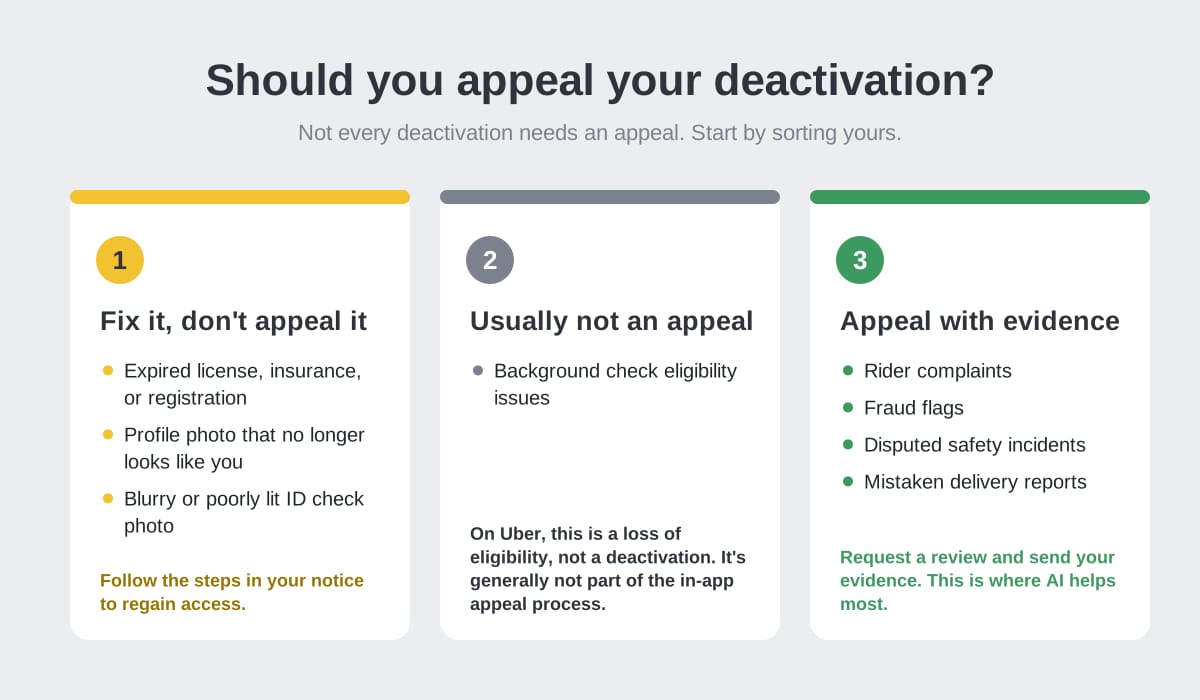
Here's the first thing I’d tell any driver, not every deactivation needs an appeal. There are basically three buckets.
Fix it, don't appeal it: If your driver's license, registration, insurance, or another required document expired, fix the problem. If your profile photo is outdated or identity verification failed because of a technical or photographic issue, correct it. There is no prize for writing 800 words explaining why your expired document should somehow be considered valid.
Usually not an ordinary deactivation appeal: Background-check eligibility issues are different. Uber treats a failed background check as a loss of eligibility, not a deactivation, so it generally isn’t part of the in-app appeal process.
Worth appealing with evidence: This is where AI can help. Complaint-driven deactivations, fraud allegations, disputed safety incidents, mistaken delivery accusations, or situations where you have dashcam footage, messages, GPS records, receipts, photographs, or other evidence that contradicts the allegation. The key word is evidence. Saying "I have been driving for 10 years and Uber is treating me unfairly" is not evidence.
How do I appeal an Uber deactivation?
Uber says drivers and delivery people can request a review of an account deactivation and provide additional information supporting their case. Its in-app Review Center can accept supporting material, including audio or video recordings, and Uber says some reviews can also be started through support.
I couldn’t find a published appeal deadline on Uber’s help pages, so check the notice in your app and the current Review Center instructions before submitting.
Your appeal should answer one question: Why is the stated reason for deactivation incorrect or incomplete?
Don't write about your mortgage, your children, your 4.98 rating, or how much money you have made for Uber over the years unless it directly supports your case. Give Uber facts that can actually be checked.
How do I appeal a Lyft deactivation?
Lyft says the Driver app includes an appeal button that connects drivers with a support channel dedicated to deactivation appeals. For permanent deactivations, Lyft says drivers can submit additional evidence such as dashcam footage, photographs, and police reports. Lyft says it will consider the evidence during the review.
Here’s the part that matters most: Lyft says you get one appeal per permanent deactivation.
If Lyft upholds the decision, it says it won't consider additional appeals unless new information becomes available. That means you shouldn’t fire off an emotional five-line response right after you see the deactivation notice. Gather your evidence first, organize it, and then submit your best argument.
How do I appeal a DoorDash deactivation?
DoorDash says most Dashers can appeal directly through the Dasher app after receiving a deactivation notice. For some deactivations, the email directs the Dasher to an Appeal Form instead. DoorDash currently says you can generally appeal a deactivation for up to one year after the deactivation date. Read your deactivation email carefully, because DoorDash determines which appeal process applies to your situation.
How do I use AI to write my deactivation appeal?
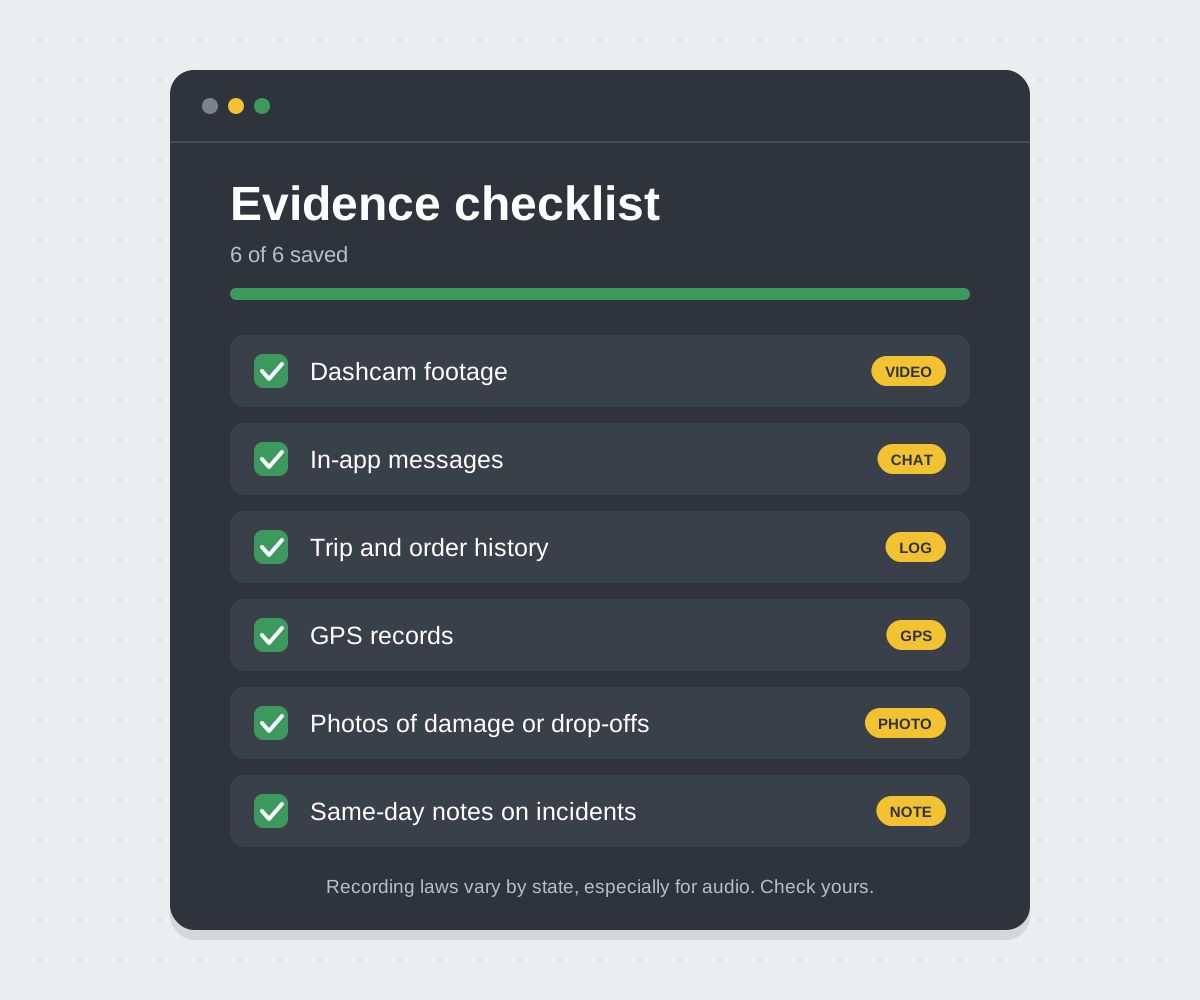
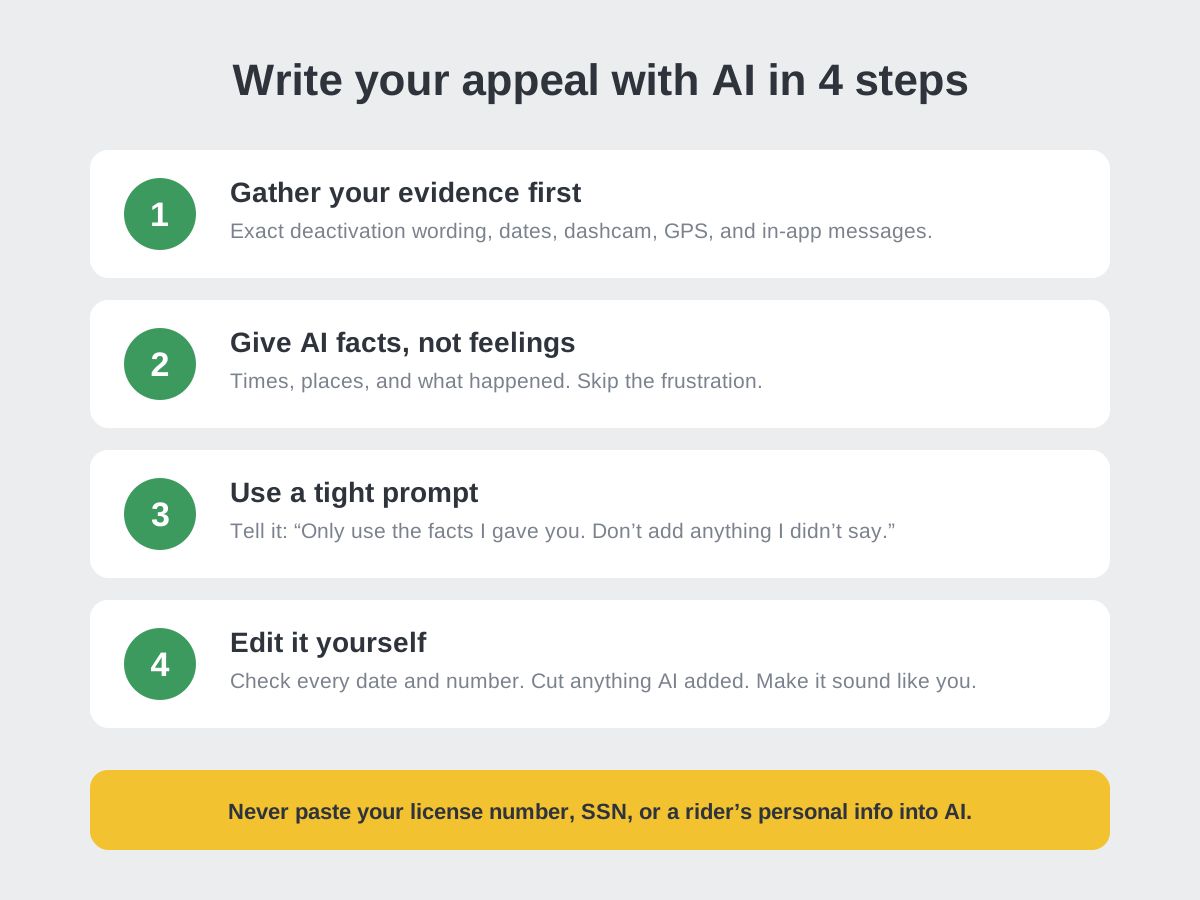
First, collect the evidence and use the exact wording of the deactivation notice. Write down the date, trip or order number if available, what happened, and exactly what you believe is wrong. Pull your dashcam timestamp, GPS information, in-app messages, photographs, receipts, screenshots, and anything else that supports your version.
Second, give AI facts, not feelings. Don't tell it, "Uber screwed me." Tell it, "Uber says I failed to complete order #1234 on September 18. I picked up the order at 7:42 p.m., arrived at the customer’s address at 8:03 p.m. I have dashcam footage and an in-app message where the customer asked me to leave it at the door.”
Then use a prompt like this:
I'm a [rideshare/delivery] driver appealing a deactivation on [app]. The reason they gave me was: [paste exact wording]. Here's what happened: [dates, trip details, your account of events]. Here's my evidence: [list each item]. Write a calm, professional appeal under 200 words. Only use the facts I gave you. Don't add anything I didn't say. Reference each piece of evidence by name.
Then do something many people skip, edit the AI response yourself. AI is a writing assistant, not your attorney and not a witness. Check every date, every number, every statement. If AI invented something, delete it. If it sounds like a corporate lawyer wrote it, rewrite it. Your appeal should sound like a professional driver explaining a specific incident, not like ChatGPT wrote an essay. And keep it short. Address the stated reason directly. No pleading. No insults. No threats.
One more rule: don’t paste your driver’s license number, Social Security number, or a passenger’s personal information into an AI tool. Describe the rider. Don’t identify them.
Learn more about how to best use AI as a gig driver.
How do I protect my account before a deactivation happens?
The best deactivation appeal is the one you never have to write. Keep your documents current and make sure your profile photo accurately represents you. Run a dashcam. It’s a deterrent, and it’s your evidence. Remember that recording laws vary by state, especially when audio is involved, so check the rules where you drive.
Document unusual incidents right after the trip ends, preferably before the rider does! If a passenger threatens you, refuses to leave the vehicle, damages something, asks you to violate platform rules, or creates some other unusual situation, don't rely on your memory three weeks later. Save the information while it is fresh.
And here's one that matters especially to delivery drivers, don't accept an order you already know you don't want to complete. There is a difference between declining an offer and accepting it and then canceling it. Uber explicitly says unusually high post-acceptance delivery cancellations can count as misuse of the platform, while DoorDash ties account access to its Completion Rate requirements.
Last, don’t build your income around a single app. If one app is your only source of offers, one deactivation takes your whole income with it. Multi-apping turns a deactivation from a shutdown into a setback.
Mystro helps you multi-app with filters you set before you accept, so you only take offers you plan to finish, and it never cancels an offer you’ve already accepted.
What to do if you get deactivated from Uber, Lyft, or DoorDash
A deactivation is serious business. Don't treat the appeal like a customer-service complaint where you type, "Please, reactivate my account." Think like a small-business owner defending your business. Stay calm and don’t panic when you get the dreaded deactivation email. What exactly are they accusing you of? What actually happened? What evidence do you have? And what specific information could change the decision?
AI can help you turn those answers into a clean, professional document in a few minutes. It can remove the emotion, organize the timeline, and make sure you address the actual allegation instead of going off on a tangent. But AI can't create evidence you don't have.
The lesson is simple: don't wait until you're deactivated to start documenting your work. Your dashcam, screenshots, trip history, messages, receipts, and records may be worth far more than the angry paragraph you were planning to send to support.
Sergio@Mystro
This post first appeared in The Mystro Newsletter — driver tips, earnings strategies, and Mystro updates, in your inbox every week.