Does your acceptance rate matter?
Learn what chasing a high AR costs you, and why cherry picking usually pays more.

This week, Thortok runs the math on what a high acceptance rate actually gets you across Uber, Lyft, DoorDash, and the other top gig apps. But before you jump in, tell us what you want to see in your inbox next week. Share your ideas here.
No. Your acceptance rate (AR) doesn't matter, in the sense that you could have a 0% acceptance rate and there’s no threat to your account. In fact, chasing a high acceptance rate can actually lower your overall profits, especially your per-hour metrics.
Gig platforms offer various incentives to get you to raise your acceptance rate (like prioritizing you to see better offers before other drivers), but a low AR can’t get you deactivated and won’t cut the pay of the offers you see.
In this article, we will break down what you get for having a high AR, and why, in spite of that, leveraging a low AR is a more profitable choice.
Note: Thresholds are not national. DoorDash, Uber, Lyft, and Uber Eats all say requirements “depend on the area” and tell drivers to check the app. Numbers below are the typical U.S. ranges from official help pages and commonly reported markets as of September 2026. In upfront-pricing markets, destination and fare are often shown to every driver, so that perk is no longer an acceptance-rate reward.
What a high acceptance rate will get you
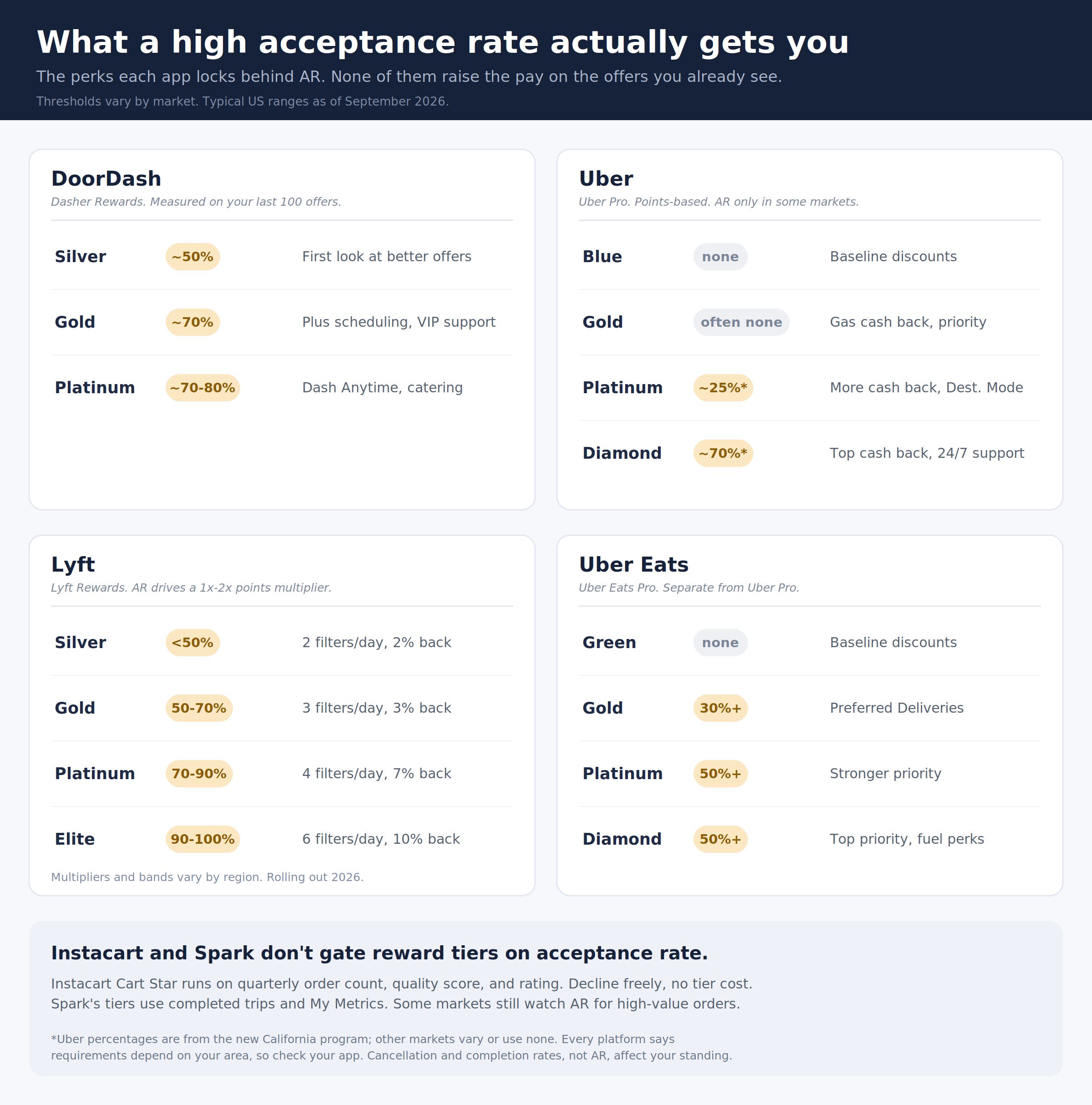
A high AR moves you up the reward tiers, and those tiers unlock things like first look at higher-paying offers, the freedom to work unscheduled hours, cash back on gas or charging, better support, and airport or scheduling perks.
Notice what's not on that list: none of it raises the pay on the offers you already see. You're being rewarded with a better shot at good offers, not with better offers. And the perks drivers actually want tend to sit at the top tiers, which is exactly where the AR you have to maintain costs you the most in bad offers.
Platform | Can low AR deactivate you? | Does it cut your offers? | What it gates |
|---|---|---|---|
Uber (rideshare) | No | No | Uber Pro tier. Perks and, in some cities, a published AR floor for Platinum/Diamond. Not the fare on the offer. |
Lyft | No | No | Lyft Rewards points multiplier and tier perks. NYC only: 85% AR to see upfront trip details. |
DoorDash | No | Not officially. You still get offers. | Dasher Rewards (Silver/Gold/Platinum): Priority Access, scheduling, Dash Anytime. Completion rate is the standing metric. |
Uber Eats | No | Not officially. Preferred Deliveries change which offers you see first, not whether you get pinged. | Uber Eats Pro. Typical floors: ~30% Gold, ~50% Platinum/Diamond (higher in some cities). |
Instacart | No. Instacart does not use AR. | No | Nothing. Batch priority comes from quarterly order count, quality score, and 4.7+ rating. |
Spark | No. AR is not a rewards qualifier. | No | Nothing via AR. Tiers use completed trips, customer rating, and My Metrics (on-time, quantity found). |
Does acceptance rate matter on Uber?
No. Uber dropped acceptance-rate deactivations years ago, and a low AR won't shrink the offers you're sent. All it touches is your Uber Pro status, which runs on points banked over a three-month cycle. In some markets, AR factors into reaching Gold, Platinum, or Diamond (the new California program sets Platinum at 25% and Diamond at 70%), and those tiers unlock gas and charging cash back, priority support, and airport or roadside perks.
None of it raises the pay on an offer, and in upfront-pricing markets everyone sees the fare and destination anyway. The metric that actually affects your standing is your cancellation rate.
Does acceptance rate matter on Lyft?
No, not for your account. A low AR can't get you deactivated and won't cut your offers. On Lyft, it drives a points multiplier: under 50% AR, you earn points at 1x, and the rate climbs to 1.5x, 1.75x, and 2x as your AR rises through the Silver, Gold, Platinum, and Elite tiers. Higher tiers mean more daily location filters, bigger Lyft Direct cash back, and better airport and scheduling perks.
The one real exception is New York City, where you need an 85% AR just to see upfront offer details. Lyft also runs a separate trap called priority mode, which we break down below.
Does acceptance rate matter on DoorDash?
No, and this is where drivers worry most, so let's be clear: a low AR can't deactivate you, and DoorDash doesn't officially reduce your offers for it. Your standing is governed by completion rate, not acceptance rate.
What AR does gate is Dasher Rewards. Around 50% AR unlocks Silver and its first perk, Priority Access, which is first look at higher-paying offers. Roughly 70%, up to about 80% in some markets, gets you to Gold and Platinum, which add advanced scheduling, VIP support, large and catering orders, and Dash Anytime, the freedom to work unscheduled even when the zone is full. Real perks. Just remember what it costs to reach them: accepting a lot of offers you'd otherwise decline.
Does acceptance rate matter on Uber Eats, Instacart, and Spark?
For two of the three, it doesn't factor in at all. Instacart doesn't use acceptance rate, period. Its Cart Star tiers come from your completed order count over the quarter, your quality score, and a 4.7 rating, so you can decline batches freely with zero standing hit. Spark is the same story: acceptance rate isn't a rewards qualifier, and drivers report it was pulled from the My Metrics screen in 2026.
Uber Eats is the one delivery app where AR carries weight, feeding Uber Eats Pro much like rideshare does, with roughly 30% needed for Gold and 50% for Platinum in most markets. Even there, a low AR only changes which offers you see first through Preferred Deliveries. It never stops the offers from coming.
What a low acceptance rate (cherry picking) will get you
Money. That’s what it’s all about, isn’t it?
The point of the Acceptance Rate metric that the platforms use is to try to ‘reward’ you for taking all the offers they throw at you: no matter how bad they are.
So by chasing those rewards, you have to take a profitability hit on the vast majority of the rides you take. Over time, even over the simple 100 offers it takes to adjust/affect your AR, you are far more profitable by choosing the best offers and rejecting the rest (also known as cherry picking) than you are by sucking up all the trash offers that are thrown to you.
The math on this is pretty easy. If you are getting slow, low-paying offers that pay you $3 or $4 a trip, and in an hour you do at most maybe four of those rides, you’ve made about $16.
Or, alternatively, you could ignore dozens of $4 offers, and then an offer comes in for $20. You drive that trip, then after dozens more ignored offers, another offer comes in for $18.
So with a high AR you did four trips in an hour and made $16, and with an extremely low AR you did two trips in an hour and made $38.
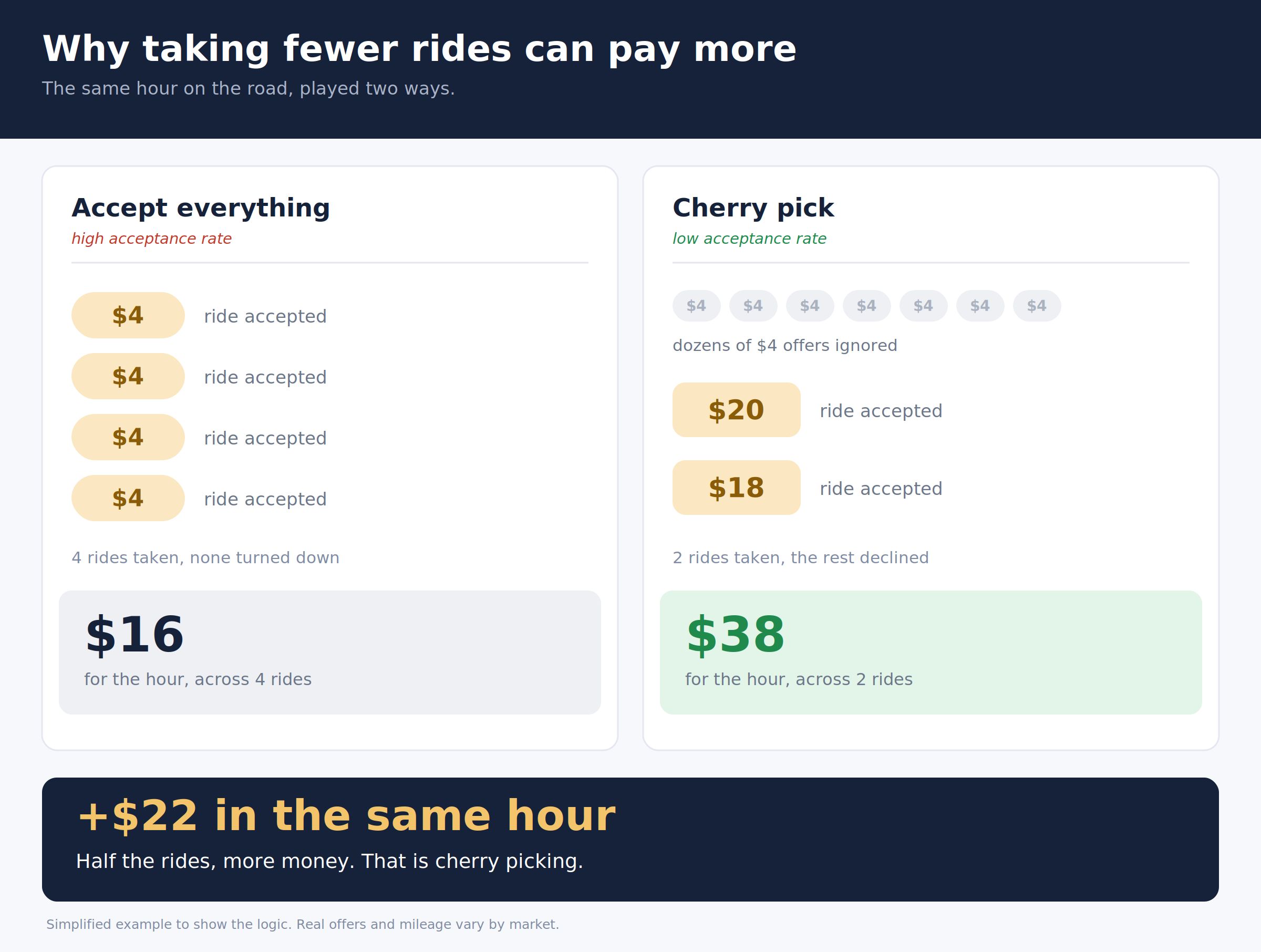
That’s a pretty weighted example, though (and doesn’t factor in other variables like mileage). Realistically, you’re looking at each offer individually and reviewing its profitability in the moment. Take this offer or don’t take it? If you are also predicting surges and using other strategies to maximize your offer density, it should not be hard to come across profitable trips to take, even if it means declining several lower offers first.
Mystro, of course, makes it easy to review these offers and automate the “is it good or is it bad” decisions based on the filters you have customized. That way you can focus on driving and keep your eyes and hands off your phone.
With properly set filters (that take into account your current market and offer density), cherry picking gets you so much more money (especially on a per-hour basis) that it’s usually larger than the benefits you’d get from the perks offered by the platforms (especially as the perks people want most always sit at the highest tiers).
A lot of drivers feel like you’re able to make more money if you have those perks (like priority in getting offers). But it’s a “two steps back, one step forward” situation on the cost to get those perks; having to take all the low-paying offers just to earn that benefit. Just cut out the middle step, and cherry pick the higher earnings now instead of trying to get priority on being offered them. If you position yourself (in time and place) somewhat away from other drivers, then you don’t need priority over other drivers, reducing the benefit of that perk in the first place.
One last thing that a low acceptance rate may do in the long run (especially if you drive at times/places with low driver density, or the other drivers in your area also have low acceptance rate): It pressures the platforms into offering better pay. Rarely will declining an offer bring it back with better pay, but those are exceptions. You might see an effect in the long term, with more surges offered more frequently in your market because fewer drivers accept bad offers. Every time you decline a ride, you are putting one more drop in the bucket of telling the platforms that you won’t work for bad offers.
Important note: Another metric to remember is cancellation rate (or completion rate on DoorDash), which works differently. If you accept an offer and then cancel it after having already accepted, this will affect your standing with the platforms. The platforms warn that they can and will take action on drivers who cancel repeatedly. Since some canceling may be necessary in certain valid situations, unnecessary canceling is a risk you shouldn’t take and is disruptive to customers and other drivers.
Should you turn on Lyft priority mode?
No. Never. A conversation about acceptance rate should also mention this special trap from Lyft: Priority mode. It’s a toggle that Lyft tries to tantalize you with, and once you turn it on, you accept a pay cut but see offers before other drivers who haven’t turned on the mode, ostensibly leading to more rides. It relates to acceptance rate because it revolves around accepting more lower-paying rides instead of fewer higher-paying ones.

The main point is that priority mode doesn't magically make more customers appear who need rides. The pay cut is guaranteed, and the increase in ride offers isn’t.
The only difference is whether other drivers are around you and whether there’s a mix of who’s using it and who isn’t. If you’re using it and others aren’t, you see offers first. If you’re not using it and others are, you’ll see fewer offers. But if there’s no mix and all the drivers in the area have it on or off, then the number of offers is unaffected; only your pay for them is.
And even if other drivers are using it, at that point it’s a ‘race to the bottom,’ and you’re honestly better served by finding a better time/place to drive that’s away from those drivers (just like you would be even if priority mode wasn’t a thing). Trying to win that race to the bottom just makes everyone lose. If all the drivers turn it on, you all get paid less with no benefit (because all the other drivers have it on too). All the other drivers turning it off is a small form of collective action to avoid the pay cut.
Here’s the juiciest part of the trap that they bait you with… If your earnings are below what you would have made without priority mode, they’ll compensate for the difference. Seems like a “can’t lose” scenario, right?
Problem is, the requirements to qualify for that compensation are pretty steep. You have to drive for at least one hour, complete at least one ride, and can’t reject more than three offers in that hour (only California and Colorado block that 3-reject-or-less requirement). Basically, you have to completely abandon the cherry-picking strategy if you want that compensation. And even then, you’re only compensated up to what you would have made without it (although it’s really difficult and obscure on how to fact-check their math on that). So why not just make what you would have made without it in the first place? Cherry picking as a strategy often makes more than what they estimate you’d make.
When I first started driving, I used priority mode a lot. I used it for a whole month. Then I went a whole month not using it. I actually earned more in the month without it. And this was before I even started using Mystro and cherry picking.
Download Mystro and set-up personalized filtering.
You might ask, what about if you’re seeking quantity of rides instead of quality, like for some kind of quest that requires X amount of trips? (Though in my market, I haven’t seen one of those on Lyft for a long time.) Even then, those quests are themselves restrictive: if you’re 1 ride short of the required number, you don’t get anything at all. And even if you do get the quest bonus, it often fails to make up for the earnings cost of taking multiple low-value rides. Those quests are often not worth it to try to aim for in the first place.
There just isn’t ever a time where priority mode is worth it. Don’t turn it on.
When a high acceptance rate is actually worth it
First, think about how acceptance rate is calculated. It’s based on your last 100 offers. Each offer you accept or reject knocks the 101-offers-ago offer off of your history.
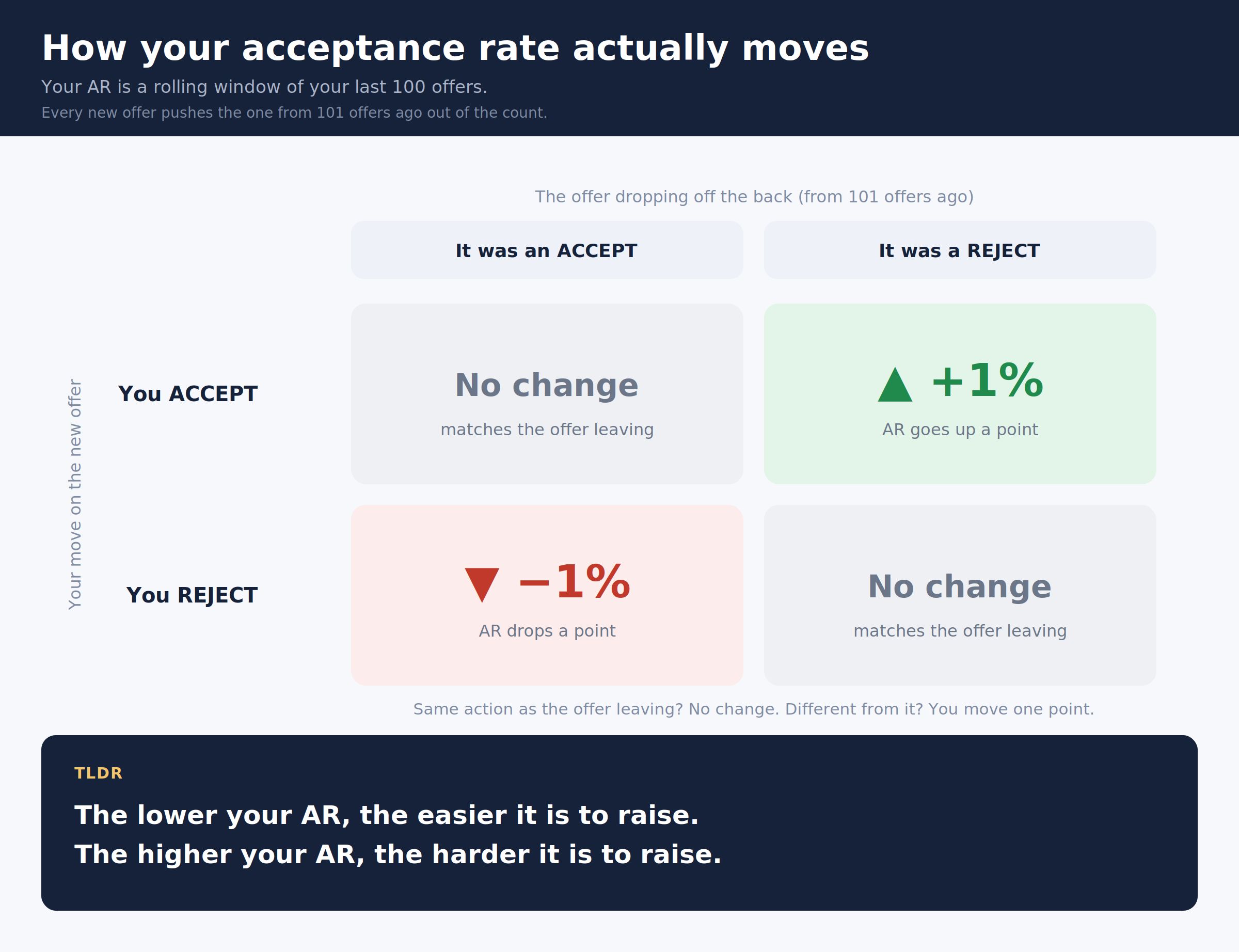
Don’t like the math? Here’s the TLDR: The lower your current AR, the easier it is to raise it, the higher your current AR, the harder it is to raise it.
So the first rule of “when high AR is worth it” is… when you already have it. If you are at or near the tier of rewards you want to be at, and you are getting perks or benefits you want to keep, then there is some value in staying there (or working to get to the tier you’re already close to) instead of giving it up, especially if you are satisfied with your current level of earnings.
For instance, especially for new drivers, Dash Anytime from DoorDash Rewards (or monthly Top Dasher from markets that still have it) may be worth it, since the alternative is being locked out of the flexibility of unscheduled Dash Now earning.
And while the general rule will be that adjusting your time and location to find a more profitable market will be the better choice… not everyone has that option. Maybe you have a job or other responsibilities, so you have limited windows of availability.
So the second rule of “when high AR is worth it” is when you don’t have a choice, and the low, non-cherry offers are the only offers you’re going to get. At that point, ‘worth it’ is doing a lot of heavy lifting because it’s treating the perks and benefits of high AR rewards as basically a consolation prize for having a bad market or bad availability for scheduling during high demand periods. If this is your situation, the honest choice now becomes whether to find a different source of income.
The math that actually moves your hourly
Acceptance rate doesn’t directly affect your hourly earnings. In a given hour, and with enough offer density, you basically have a choice between a handful of low-value offers or a potentially smaller amount of high-value ones.
If you shrink it down even more on a per-offer basis, the only reason to ever take a low-value offer is if you are very certain that a high-value offer is not going to happen soon enough. “Take the best offers, ignore the rest” is just the common-sense way of making the most money as quickly as possible.
Use Mystro to accept the best offers.
Accepting everything because you’re afraid no good offers will come along is just letting the platform weaponize your FOMO (fear of missing out) against you. It’s just as bad as chasing surges that turn into deadzones, or driving in circles in deadhead. You don’t want every offer; you want just enough offers to hit the sweet spot on the bell curve of staying busy.
How to run a low acceptance rate on purpose
Having a low acceptance rate and cherry picking is the strategy that most drivers recommend when per-hour earnings are the goal. And in markets with high offer density, scanning/reviewing multiple offers a minute (especially while trying to drive!) is quite tasky.
Enter Mystro, the cherry picker’s dream. Program your filters in Mystro and let it handle the rest. It will automatically accept or reject based on what you tell it you want. You can even leave a window in between for when you still want to make manual decisions.
It also automatically takes you offline in the platforms you’re not using when you are on a trip with a different platform, so you don’t get spammed with offers from one platform while you’re busy with another.
All in all, using Mystro with a sound cherry picking strategy will very likely get you to those earnings we all aim for. Good luck!
Now we want to hear from you. Tell us how you navigate acceptance rates and what other topics you want to read about.
This post first appeared in The Mystro Newsletter — driver tips, earnings strategies, and Mystro updates, in your inbox every week.