How to run multiple delivery apps at the same time
The pause-and-resume loop that makes multi-apping pay, the mileage catch at tax time, and the mistakes that quietly cost drivers money.

Yes, you can run DoorDash, Uber Eats, and Grubhub at the same time. You’re an independent contractor, and plenty of drivers do it to cut the dead time between orders. What makes it work is one loop you repeat all shift: accept the best offer on one app, pause the others before you pull away, and turn them back on after drop-off. Skip the pause and offers keep landing on apps you can’t serve. They expire, count as declines, and chip away at your acceptance rate.
This guide covers what that loop looks like in practice, why drivers take it on, the tax and legal fine print most guides skip, and the mistakes that quietly cost money.
Let an app run the loop: When you accept an order, Mystro takes your other apps offline and brings them back after drop-off, and it filters offers by your own rules, so a second app stops feeling like a second job.
What multi-apping actually involves
Multi-apping isn’t the same as leaving every app you’ve signed up for switched on. It’s a set routine: run two or more apps at the same time, compare the offers that come in, accept the one worth taking, then pause the apps you didn’t choose until that delivery is done. When the order is complete, everything comes back online and the cycle starts again.
That difference matters because the sloppy version, every app on and nothing paused, causes the exact problems drivers blame on multi-apping. Offers pile up on an app you can’t take them on. You accept orders that overlap with one you’re already running. Acceptance rates slide on apps sitting idle while you’re 20 minutes into a delivery for someone else.
Most offer cards show pay, distance, and an estimated time. What they usually don’t show is your $/hr or $/mi, so that math lands on you, under a countdown. Add the decision itself: choosing between competing offers, again and again, while the car is running. That wears you down over a long shift.
Driving Uber and Lyft instead: The guide to driving for Uber and Lyft simultaneously walks through that pairing step by step.
Why drivers multi-app
The main reason is downtime. A single app has dry spells, whether from too many drivers nearby, a surge that ended, or a slow stretch between meal rushes. A second live app fills those gaps with offers the first one isn't sending, and it protects you when one app's algorithm sends its orders to other drivers for an hour. Drivers who multi-app also spread their income across apps, so a deactivation, a slow week, or a pay change on one app doesn't wipe out their income.
Plenty of drivers already work this way. A 2026 Flex Association survey, run by Morning Consult, found that 77% of people who have earned on gig apps used two or more apps in a work period [1]. Flex is the industry group for the big gig apps, and surveys of drivers in California and Seattle found similar numbers:
Survey | Who was asked | Share running more than one app |
|---|---|---|
Flex Association and Morning Consult (2026) | 4,256 current and past app-based workers in the US | 77% earned on two or more apps in a work period [1] |
National Equity Atlas and Rideshare Drivers United (2021) | 531 California rideshare drivers | 66% drive for more than one app [2] |
City of Seattle driver survey, analyzed by Parrott and Reich (2020) | 6,789 Seattle rideshare drivers | 52% drive for both Uber and Lyft [3] |
Each survey asked a different group a slightly different question, but they point the same way: running more than one app is normal. Whether it pays for you comes down to your market, meaning how many orders come in and which apps are busy where you drive. If two apps both have steady orders, running them together cuts the wait between offers.
More ways to earn: The guide on increasing earnings as a rideshare driver covers the other levers, and the free DoorDash Heatmap shows where restaurant orders cluster by hour and day, so you can pick a starting spot before your shift.
The manual workflow drivers actually run
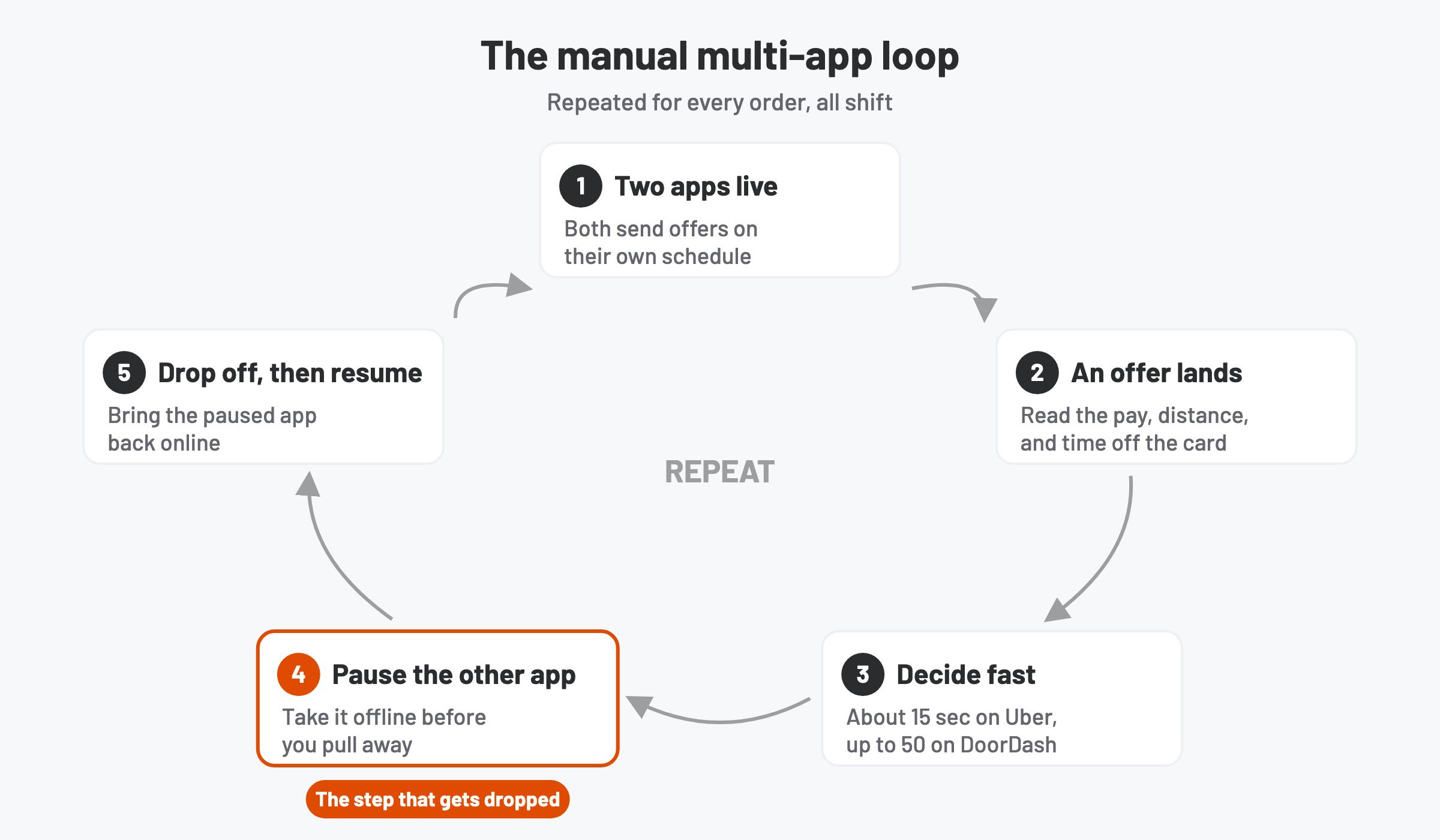
Without a tool, the manual version looks like this, repeated for every order:
Two apps sit live, each sending offers on its own schedule.
An offer lands. You glance at the phone in the mount and read the pay, distance, and estimated time off the card.
You decide before the countdown runs out, sometimes while a second offer arrives on the other app.
You accept one, then switch to the other app and take it offline before you start moving.
After the drop-off, you bring the paused app back online.
Nothing in that list is hard on its own. The trouble is that it never stops, and step 4 is the one that gets dropped. Forget to pause, and an offer you can’t take arrives mid-delivery, expires, and takes a bite out of your acceptance rate.
Research on app-based delivery drivers points to time pressure and the pull of on-time rates and tips as reasons drivers speed [4], and that pressure comes with the job whether you run one app or three. So do your switching while you’re parked: pause the other apps right after you accept, before you start moving, and turn them back on after the drop-off. Later in this guide, we cover how to hand that loop off entirely.
The legal and tax fine print most driver content skips
Running apps at the same time changes two things: how your miles count at tax time, and whose rules you’re following.
Start with miles. Oregon’s Department of Revenue doesn’t accept “online” miles, the miles you drive while an app is on, because two open apps count the same mile twice [5]. It does accept miles from trips you were booked on, plus miles between bookings that you log as you go: date, start, end, miles, and business purpose. So keep a trip-by-trip mileage log instead of relying on app-on totals.
The rideshare taxes guide covers deductions and quarterly payments in more detail.
On the legal side, no law we found bans multi-apping. You’re an independent contractor, and you choose which apps you run. Each app can still set its own terms in its driver agreement, so that’s the rulebook to check.
How automation changes the workflow
Automation doesn’t remove the decisions. It moves them earlier, from the middle of a shift to before it starts. Instead of judging every offer against a countdown, you set the rules once, and the app applies them.
It handles two jobs. Offer filtering replaces reading and dismissing every low-paying offer by hand, and accepting a good one before the window runs out. The app-switching loop replaces the pausing and turning back on around every order, which is the step that slips when a shift gets busy.
Feature | What it does |
|---|---|
App switching | Pauses your other connected apps when you accept an offer and brings them back online after the drop-off, without manual toggling |
Auto-reject | Declines offers that miss your reject rules |
Auto-accept | Accepts offers that meet your accept rules, before the app’s decision window runs out |
Offers in between | Shows up on screen for you to decide |
Aggregated earnings | Calculates $/hr and $/mi across your connected apps in one view instead of app by app |
The rules are yours to set: minimum pay, your $/hr and $/mi minimums, maximum pickup distance, and similar limits. Set up your filters, then adjust them over your first few shifts. You don’t have to choose between all-automatic and all-manual. Offers that land between your accept and reject rules show up on screen for you to decide, so the borderline ones still get a human look. By default, Mystro still lets the same app send you a stacked order, but blocks offers from your other apps while you’re on one.
Running rideshare and delivery in the same shift? Here's how the two compare on pay and costs, and our roundup of apps for managing multiple platforms covers the rest of the toolkit.
Common mistakes that cost multi-app drivers money
Accepting overlapping orders: Taking a second offer before the first is done creates a double-booking neither customer benefits from. One order runs late, sometimes both, and the ratings damage lands on two apps at once. Stacked orders from the same app are fine. The trouble is two separate orders from two different apps, each with its own clock.
Forgetting to pause the inactive app: The most common one, and the easiest to fix. Offers arrive on an app you can’t serve, expire untouched, and pull your acceptance rate down on an app you weren’t even using.
Skipping the $/hr and $/mi math: More orders isn’t more profit. An offer that pays well in dollars can lose money once the deadhead miles to the pickup are counted, and multi-apping makes it easier to chase volume without checking the rate.
Treating more apps as the strategy: There’s no magic number, but past two or three apps, the switching overhead tends to eat whatever extra offers you gained. Pick the apps that pay best where you drive. Here's which apps pay the most.
Copying advice written for another market: Advice written for a dense city with four busy apps doesn’t carry over to a smaller market with two. Drive in rural areas? Here’s our advice.
Multi-apping FAQ for delivery drivers
How do multi-app drivers switch between apps?
Most do it by hand: accept on one app, open the other, take it offline, then reverse it after the drop-off. Tools like Mystro handle that toggling as part of an app-switching loop, so it happens without you touching the screen mid-shift.
Can I run Uber, Lyft, and DoorDash at the same time?
Yes. Nothing stops you from having all three live, and it’s a common combination in US markets. What you’re managing is the switching: pausing the two you didn’t accept on, and bringing them back after each order.
Yes. Plenty of drivers run Uber or Lyft alongside DoorDash or Uber Eats and take whichever offer pays better. The loop is the same: pause the other apps while you’re on a ride or an order, then turn them back on. Passengers and food pay differently, so check how rideshare and delivery compare on pay and costs before you pick your mix.
Is multi-apping allowed?
Yes. You’re an independent contractor, and no law we found bans running more than one app. Each app can still set its own terms in its driver agreement, so those terms are what apply to you.
Does multi-apping hurt my acceptance rate?
Only if the inactive app is left live during a delivery. Offers that arrive and expire while you’re busy count against you. Pausing the app you didn’t accept on, by hand or automatically, is what prevents it.
Can I deduct all my miles if two apps are open at once?
Don’t count on it. Oregon’s Department of Revenue doesn’t accept “online” miles because two open apps count the same mile twice [5]. Other tax authorities may see it the same way. Keep a trip-by-trip mileage log, and see the rideshare taxes guide for the rest.
How to multi-app DoorDash and Uber Eats without the manual switching
If the pause-and-resume loop is the part you keep dropping, that’s the part Mystro handles. Set your accept and reject rules once. Mystro takes your other apps offline when you accept an order and brings them back after drop-off. More than 100,000 drivers use it, and Mystro drivers earn up to 30% more.
References
[1] Flex Association and Morning Consult. “State of the App-Based Economy in 2026.” Flex Association, June 2026. https://www.flexassociation.org/wp-content/uploads/2026/06/MC-DECK-State-of-the-App-Based-Economy-in-2026.pdf
[2] Eliza McCullough and Brian Dolber. “Most California Rideshare Drivers Are Not Receiving Health-Care Benefits under Proposition 22.” National Equity Atlas and Rideshare Drivers United, August 19, 2021. https://www.nationalequityatlas.org/research/analyses/rideshare-drivers-healthcare-prop-22
[3] Parrott, James A., and Michael Reich. “A Minimum Compensation Standard for Seattle TNC Drivers.” Report for the City of Seattle, July 2020. https://www.seattle.gov/documents/Departments/LaborStandards/Parrott-Reich-Seattle-Report_July-2020%280%29.pdf
[4] Kyla Hagan-Haynes, Ashley Brooks-Russell, Srinivas Konda, Kaitlin Wingate, Eric Lundstrom, Hope Tiesman, Imelda Wong, Natalie V. Schwatka, Virginia Visconti. “Do you speed when you dash? A qualitative study of app-based food delivery drivers.” Transportation Research Interdisciplinary Perspectives, Vol 37, May 1, 2026. https://www.sciencedirect.com/science/article/pii/S2590198226001399
[5] Oregon Department of Revenue. “Gig Work.” Oregon.gov (Department of Revenue). https://www.oregon.gov/dor/pages/gig-work.aspx
This post first appeared in The Mystro Newsletter — driver tips, earnings strategies, and Mystro updates, in your inbox every week.